

Your summer is full and your winter is empty, and discounting rooms to the same vacationers who aren't traveling doesn't change that. Hotel off-season marketing works when you stop chasing leisure guests who aren't coming and go after the people who still need a bed in your town in the slow months: work crews, families traveling for funerals and people on longer stays.
Seasonal owners describe the problem bluntly. In a Reddit thread from a seasonal hotelier with six months under 10 percent occupancy, the owner describes half the year with the property close to empty. The replies from other hoteliers didn't suggest better ads. They pointed at different guests.
Below is how I'd find those guests in your market, the pages and Google profile changes that reach them, and what I'd avoid.
Why hotel off-season marketing fails when it's just a discount
A price cut only works on people who were already thinking about traveling. In the off-season, most of your leisure guests aren't. Cutting the rate hard tells the few who are that your place is cheap, and it trains your summer guests to wait for the deal.
There's a second problem. Most seasonal properties sell through the online travel agencies, and in a Reddit thread on what Booking.com really charges hotels owners describe commission of roughly 13 to 25 percent once the preferred and Genius programs are added. A discounted winter room sold through that channel may not cover the cost of cleaning it. The guests you want in the slow months usually book differently: by phone, by the week, often through their employer.
The off-season demand hoteliers actually point to
In a Reddit thread where hoteliers shared how they fill slow months, the answers were practical: construction crews, crew lodging programs such as CLC, and bereavement rates for families in town for a funeral. None of that is glamorous. All of it is people who have to be somewhere regardless of the season.
- Construction and work crews. Road, utility, pipeline and building projects run through the winter in many areas. Crews need rooms for weeks, parking for trucks and trailers, and an invoice their employer can pay.
- Crew lodging programs. Companies that move workers around often book through a lodging program rather than a travel site. Hoteliers mention CLC by name. Being set up with the programs the crews in your area use puts your property on a list the travel sites never see.
- Funerals and family emergencies. Families travel on short notice in every season. A bereavement rate, with a simple way to ask for it and flexible cancellation, is something a stressed family will search for and remember.
- Extended stays. People in town for a work contract, a house renovation or a family member's treatment want a weekly rate, a kitchenette or microwave, and laundry. They book once and stay a long time.
Which of these exist in your town is a local question. The next section is how I'd answer it.
How to find and win off-season guests, step by step
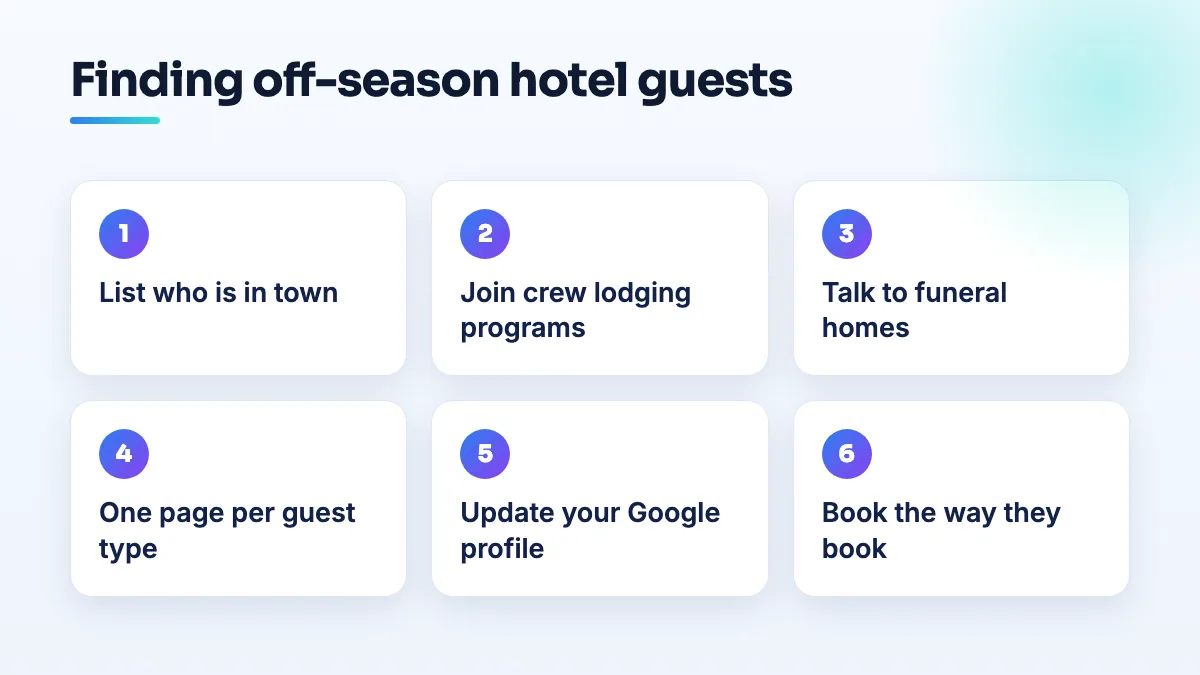
- List who is in town in your slow months. Check your county or city planning pages for large projects scheduled over the winter, and look at who is working on the roads and utility lines near you. Call the general contractors and ask where their out-of-town crews stay now.
- Ask to be added to crew lodging programs. Find out which lodging programs the companies in your area use, and apply to the ones that fit your property. Have your weekly rate, parking details and billing terms ready before you call.
- Talk to funeral homes and places of worship. Ask the funeral directors in your area whether they keep a list of nearby places to stay for visiting families. Give them a bereavement rate and a direct phone number that a person answers.
- Build one page on your website for each kind of guest. A work crew page, a bereavement rate page and an extended stay page. Each one says what that guest needs to know, in their words (details below).
- Change your Google profile for the season. Update your photos, amenities and posts so they show what off-season guests care about. Post the crew and weekly rates, with the link going to the matching page.
- Take the booking the way they want to book. Crews and program bookings come by phone and email, not from a travel site. Answer the phone, reply the same day, and have a simple invoice ready.
What each off-season page needs
Each page has to answer a different guest's questions. I'd never put them all on one "Special Offers" page, because nobody searches for that, and a crew foreman and a grieving family want completely different things.
| Page | The kind of search it answers | What to put on it |
|---|---|---|
| Work crew lodging | Construction crew lodging or a work crew hotel near your town | Weekly and monthly rates, truck and trailer parking, early breakfast or coffee, laundry, how you invoice companies |
| Bereavement rate | A hotel bereavement rate near a funeral home or cemetery | How to ask for the rate, what it covers, flexible cancellation, distance to the funeral homes and churches nearby |
| Extended stay | Weekly or extended stay rooms in your area | Weekly price, kitchen or microwave, laundry, housekeeping schedule, quiet rooms away from the road |
Write the pages with real details: the actual number of truck spaces, the actual weekly price, the actual distance to the hospital. That's what makes a crew manager call you instead of the chain by the highway. If you don't have time to write them, this is exactly the kind of service page writing we do for hotels, and the details are what get a page found.
Your Google profile in the off-season
Most off-season guests will see your Google profile before they see your website. Two problems come up with hotels again and again, and both are worth checking before the slow months start.
- You can't always control the hotel description. Hoteliers in a Reddit thread from hotels unable to edit the about text Google shows found that the summary on their profile isn't something they can simply rewrite. So don't rely on it to tell crews about your weekly rates. Put that in posts, photos and your website, which you do control.
- Travel site photos can take over. In a Help Community thread about travel agency photos on a hotel profile, owners describe OTA photos sitting on their profile and sending people to the OTA. Upload your own photos regularly, including the parking lot, the laundry and the rooms with kitchenettes, so your pictures are what guests see.
Keep your hours and phone accurate all winter. If the front desk isn't staffed overnight in the off-season, say how late check-in runs and what number to call. A crew that arrives at 11pm to a locked door won't book you again.
If you close for part of the year
Some places are too small or too remote to stay open, and that brings its own problem. In a Reddit thread on seasonal motels losing staff through the shutdown, owners describe training a new team every spring because the old one found year-round work. Even a few months of crew or extended stay business can be enough to keep a small core team employed through the winter, which is worth as much as the room revenue.
If you do close, show it on Google honestly. Set your hours or closed status for the period you're shut and your reopening date, and add a post saying when you reopen and how to book ahead. A guest who calls a closed property and gets no answer tends to write a review about it.
What not to do in the off-season
- Don't discount your way through winter on the travel sites alone. You pay full commission on a room that earns less, and you teach summer guests to wait.
- Don't make one page for every guest type. A single "deals" page doesn't match any search and doesn't answer anyone's questions.
- Don't promise amenities you can't deliver in winter. If breakfast or the pool closes, say so. Crews and extended stay guests read reviews, and a complaint about a missing amenity lasts longer than the season.
- Don't copy the same page for every nearby town. One strong crew page that names the projects and roads you're close to beats a dozen thin copies with the town swapped.
- Don't let a travel site's booking link become your only one. Crews and families calling direct is the point. Make your own phone and booking page the easiest option.
Questions owners ask
Will work crews damage the rooms?
Set clear terms in writing, just as you would for any long stay: a deposit, a housekeeping schedule and who pays for damage. In my experience the problems come from stays that started without written terms, not from crews as such.
Is a bereavement rate worth advertising?
It's a small number of bookings, but it's the kind people remember and mention. I'd keep it simple: a page, a line on your Google profile, and a word with the local funeral homes.
Should I still run ads in the slow months?
Only for the guests who are actually traveling. An ad aimed at "crew lodging" near your town can make sense. An ad aimed at vacationers in a month when vacationers don't come mostly buys clicks.
Plan the slow months before they start
The off-season is filled in the busy season, when you have time and money to build the pages and make the calls. If you rely on the travel sites, it's worth reading how Booking.com commission cost adds up, and if you also run rentals, what I suggest for VRBO and direct bookings. If you want the pages and profile done for you, it's part of our hotel SEO work.
Written by Saifur Rifat, Founder & SEO Lead at SERP Squad.