

Your blog post takes an hour to write and then waits days for a principal to sign it off, so by the second month the content calendar has quietly stopped. The fix is to plan around FINRA 2210 content approval instead of around ideas: write in batches, submit them as a set, date every piece from its approval rather than its draft, and keep a library of pre-approved pieces for your Google profile.
This is for advisors registered through a broker-dealer, and dually registered advisors, whose website, blog and profile posts all pass through a compliance review. If you're a standalone RIA, the SEC Marketing Rule is what applies to you, and I cover that further down.
Below is what the rule actually requires, the calendar I'd build around it, and the mistakes that send approved content back into review.
What FINRA 2210 content approval requires
FINRA Rule 2210 on communications with the public sorts everything a firm publishes into three types: correspondence, retail communications and institutional communications. A retail communication is any written or electronic communication distributed or made available to more than 25 retail investors within any 30 calendar-day period. A public blog post, a service page and a Google Business Profile post can be seen by anyone, so I plan every one of them as a retail communication. Your firm's written procedures have the final say, but I've never seen a reason to plan any other way.
Four parts of the rule shape the calendar:
- Approval before use. An appropriately qualified registered principal has to approve each retail communication before the earlier of its use or its filing with FINRA.
- Filing for new firms. For the first year of a firm's FINRA membership, retail communications used in public media, which includes a generally accessible website, have to be filed at least 10 business days before first use.
- Content standards. No "false, exaggerated, unwarranted, promissory or misleading statement or claim," and no predictions or projections of performance.
- Records. The firm keeps each retail communication along with the name of the principal who approved it and the date approval was given.
There's one distinction that matters for profiles and social accounts. Posts in an interactive electronic forum, such as a live reply thread, don't need principal approval in advance, but the firm has to supervise them the way it supervises correspondence. Static content, like a blog post or a profile description, is not interactive. Whether your firm treats Google review replies and Q&A answers as interactive is a question for your compliance team, and I'd get the answer in writing.
Why most advisor calendars fall apart
The pattern is always the same. Someone writes a timely post, submits it, waits, and by the time it's approved the news it reacted to is old, so it goes up late or never. Or the post is approved, and then a marketer tweaks the headline, the title tag or the opening paragraph for search, and the version on the site is no longer the version a principal signed off.
That second one is the bigger risk. An approved post that gets edited afterwards is, in practice, unapproved content. My rule for clients is simple: anything beyond a typo fix goes back through review.
Consistency matters more in this industry than in most, because the easy searches are taken. When I looked at "financial advisor near me" for Charlotte, the top nine results were bank pages and directories such as SmartAsset's top 10 lists, Wealthtender, PlannerSearch and Expertise.com, with exactly one independent firm's own site among them. An independent advisor gets found through steady, specific content that answers the questions local clients ask. That only works if the content keeps coming out, and under 2210 it only keeps coming out if the calendar is built around approval.
How to build a content calendar around principal approval
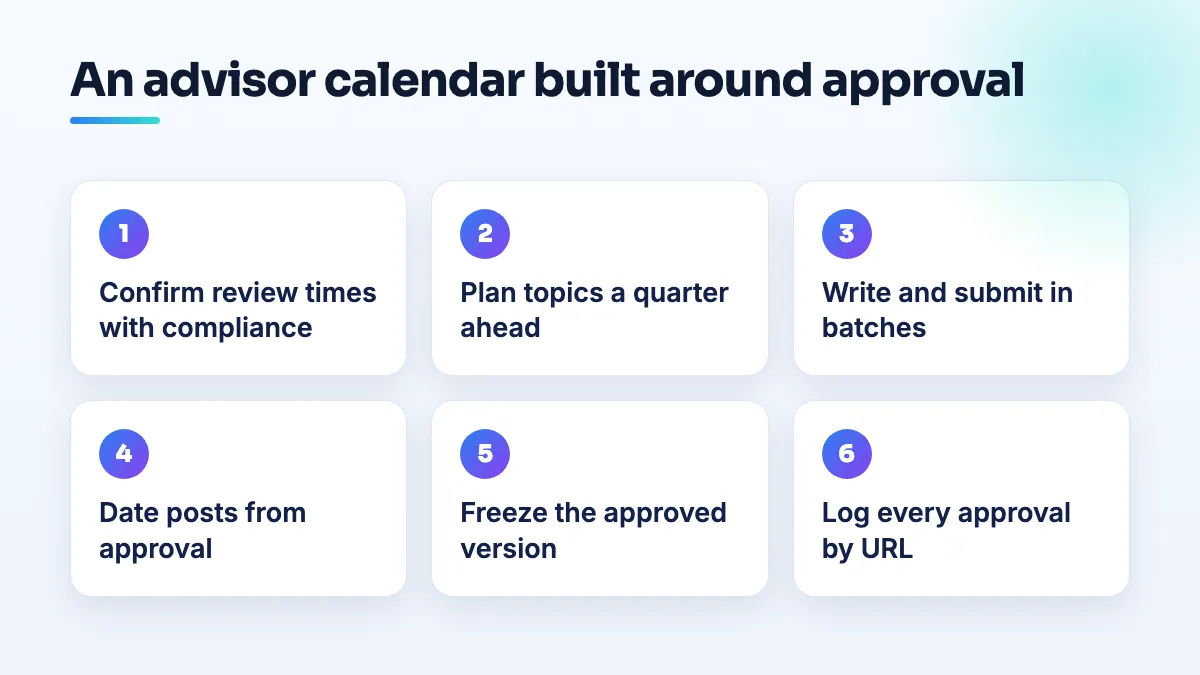
- Get your real numbers from compliance first. Ask four questions: how many business days a typical review takes, whether your firm is still inside its first-year filing window, which content types they treat as retail communications, and whether anything is pre-cleared. Write the answers at the top of the calendar. Every date below depends on them.
- Plan a quarter at a time. Pick topics about 90 days out. Most should be evergreen questions your clients already ask you: what to bring to a first meeting, how your fees work, how you approach a rollover conversation. Keep a small number of timely slots, and accept that timely under 2210 means weeks, not days.
- Write in batches and submit them together. One batch a month works for most solo and small-team advisors: a few blog posts, a set of short profile posts and any page updates. A reviewer can schedule one package more easily than a dozen interruptions, and you see every revision request at once.
- Date each piece backward from approval. The earliest publish date is the submission date plus the typical review time, plus 10 business days if you're filing, plus a few business days for revisions. With a five-day review and the filing window, that's around 18 business days, close to four calendar weeks. Put the publish date on the calendar only once the piece is approved.
- Submit exactly what will go live. The headline, the title tag, the meta description, the images, the alt text and every link go into the submission. If the SEO work happens after approval, it hasn't been approved.
- Keep an approval log for every URL. One row per piece: URL, version, date submitted, approving principal, date approved, filing reference if there is one, date published. It mirrors the record the firm has to keep anyway, and it lets you prove which version is live.
- Build a pre-approved library for your Google profile. Short evergreen profile posts (your office hours, what a first meeting covers, an upcoming workshop described without promoting a product), your profile description, and a handful of review reply templates. Get the whole library approved once, then publish from it on a schedule without starting a new review each week.
How I plan each type of content
This is how I schedule each format for advisor clients. It's a planning tool, not a legal classification: your firm's procedures decide the category.
| Content | How I plan it | Lead time I allow |
|---|---|---|
| Blog post or service page | Retail communication, principal approval before use | Review time, plus 10 business days if filing |
| Google Business Profile post | Retail communication, published from the approved library | None once the library is approved |
| Profile description and services | Retail communication, approved once and rarely changed | Same as a page |
| Review replies and Q&A answers | Whatever the firm decides, using approved templates either way | Templates approved in advance |
| Email to 25 or fewer retail investors in 30 days | Correspondence, under the firm's supervision policy | Per the firm's procedures |
Review replies deserve care beyond compliance. Client reviews shown on your site bring the SEC's testimonial conditions into play, which I explain in the guide to how the SEC Marketing Rule treats testimonials. A reply template that thanks the reviewer and never discusses their account keeps you clear of most problems.
Topics that clear review, and wording that doesn't
A calendar only holds if most submissions come back approved the first time. These are the habits I'd build into every brief:
- Explain, don't sell. A post that explains how required minimum distributions work in general is easier to approve than one that ends with a pitch for a specific product.
- Cut the promise words. "Guaranteed," "best," "never lose," "safe" and anything that predicts returns fall straight into the rule's content standards.
- Keep performance off the blog. Performance figures belong on pages built for them, with the disclosures they need, not dropped into a market commentary post.
- Date anything that changes. Contribution limits and tax figures change every year. Put the year in the sentence so an old post isn't wrong in a way a reviewer has to catch.
- Treat badges and awards as their own submission. Ratings come with separate SEC conditions; see the answer on third-party ratings and top advisor badges before one goes on a page.
If you're a standalone RIA
FINRA 2210 applies to FINRA member firms and their registered people. A standalone registered investment adviser's advertising falls under the SEC Marketing Rule instead. The SEC's release on the Marketing Rule sets the conditions for testimonials, endorsements, third-party ratings and performance, but it doesn't contain FINRA's principal pre-approval and filing steps.
That doesn't mean you should publish without a check. Your compliance manual decides who signs off marketing, and I'd still run the same batch, log and library system. It costs very little and it answers the question an examiner will eventually ask: who looked at this before it went up?
What not to do
- Don't publish first and submit later. Approval has to come before use. A post that's live "just until compliance gets to it" is in use.
- Don't let a plugin or an agency change approved pages. SEO tools that rewrite titles or insert text automatically will quietly create unapproved versions.
- Don't auto-post your blog feed to your profile or social accounts. Each of those is its own communication with its own wording.
- Don't put the firm name on a shared-office practitioner profile. Google's guidelines for practitioner profiles say that where several practitioners share a location, the practitioner's profile title should include only their name, not the organization's.
Questions advisors ask
Does a Google Business Profile post need principal approval?
I plan it as if it does, because it's visible to anyone who finds your profile. That's exactly why the pre-approved library matters: it lets you post every week without a new review each time.
How far ahead should the calendar run?
A quarter of topics, with the next month's batch already submitted. If you're in your firm's first year of membership, add the 10 business days of filing lead time to every public piece.
Can I update an old post for search?
Yes, but treat the update as a new submission and log it as a new version. Refreshing old posts is some of the best-value search work an advisor can do, so it's worth the review.
Where to start
Start with the conversation in step one, then fill the first quarter with questions your clients have asked you in the last month. If you'd rather hand over the writing, our SEO content writing is built to go through compliance review without last-minute rewrites, and it's the core of our SEO for financial advisors.
Written by Saifur Rifat, Founder & SEO Lead at SERP Squad.