

Most airport transfer companies don't have an office at the airport, so they rarely win the map pack for "car service to the airport" searches, and a lot of them spend years trying anyway. Airport transfer company ranking is won mostly in the regular results: one strong page per airport you serve, facts on those pages that a traveler actually needs, and links from the hotels, venues and travel businesses around the airport.
Operators on Local Search Forum ask about this constantly, from a thread on structuring a site around airport transfer keywords to owners watching their airport rankings collapse. Here's how I'd set up a limo or transfer company to compete, and the Google Business Profile moves I'd avoid while doing it.
Why the map pack is the hard part for airport searches
The map pack leans heavily on where your verified business address is. If your office is 20 miles from the airport, you'll show in the map pack near your office, and much less near the terminal. Adding the airport to your service area doesn't change that; I explain why in the answer on whether your service area affects Google ranking.
The tempting fix is an address near the airport. Don't. A Help Community thread about a suspended limo company shows how this goes wrong: a licensed firm with a staffed office was suspended for months, and a Product Expert, Amy Toman, found another limo company listed at the same street address with no suite number. Her point was that Google doesn't usually accept two businesses sharing an address unless they have separate suite or office designations. A virtual office or a shared desk by the airport puts you in exactly that position.
So I treat the map pack as a bonus near your real base, and I build the airport business in the organic results, where the page that answers the traveler best can win regardless of where the office is.
Be careful with transport categories
Before touching the site, one warning about the profile. Limo and transfer companies seem to be under unusual scrutiny for category changes. In a Local Search Forum thread about a limo company suspended after adding Chauffeur service, a years-old listing was suspended within minutes of adding that secondary category, with no other change. In a Help Community thread from a licensed taxi operator, Chauffeur service, Taxi service, Transportation service and Airport shuttle service were all rejected as a policy violation, and the appeal was denied.
My advice: don't add "Airport shuttle service" to your profile to chase airport searches. Set the category that matches most of your work once, leave it, and let the website do the airport targeting.
The site structure behind airport transfer company ranking
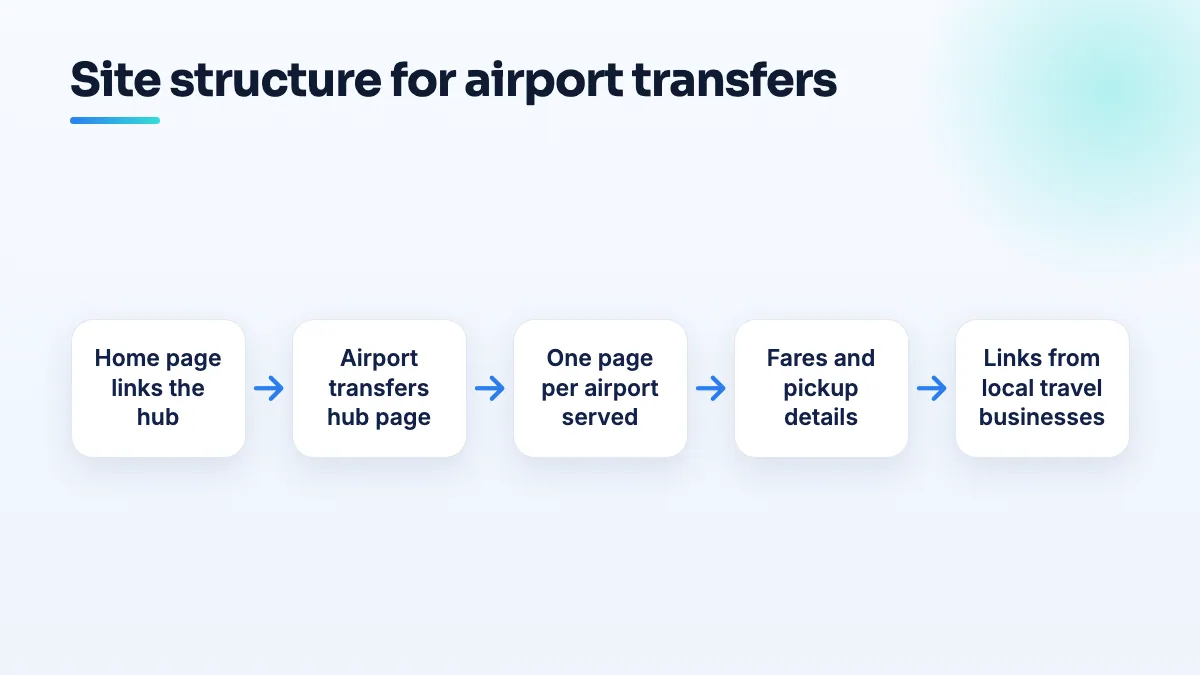
Most transfer sites I see have one "Airport Transfers" page that lists five airports in a paragraph. That page can't rank for any of them, because it isn't really about any of them. Build this instead:
- Create one hub page for airport transfers. It explains how your airport service works (booking, flight tracking, waiting time, vehicle classes) and links to a page for each airport. Link it from your main menu.
- Give every airport you actually serve its own page. One URL per airport, named for how travelers search it: the airport's name and code. Only airports you run regularly. A page for an airport you'd drive to once a year is a page you can't fill.
- Fill each airport page with what's specific to that airport. Which terminals you pick up from, where exactly the driver meets the passenger (curbside, inside arrivals with a name sign, a cell phone lot), how you handle delayed flights, how long you wait free, and anything peculiar to that airport's pickup rules. This is the detail that makes the page useful and hard to copy.
- Put fares on the page. A table of fixed fares from the main towns and hotels you serve to that airport, by vehicle class. Travelers compare on price, and a page with real fares answers the search in a way a "call for a quote" page doesn't. Mark the fares up properly too, using schema markup for your service packages.
- Add proof from that airport. Your own photos of your vehicles at that terminal, reviews from customers who mention that airport, and the number of years you've run the route if it's true.
- Add route pages only where demand and fares are real. If you run a busy fixed-fare route, such as a big town or cruise port to the airport, a route page can earn its place. A page for every town-to-airport combination is the thin, name-swapped pattern that gets whole sections dropped.
- Link them together. Hub to every airport page, each airport page back to the hub and to your booking page, and your fleet pages to the airports each vehicle serves.
Earning links from airport-related sources
In that site-structure thread, links from airport websites came up as the authority play, and I agree that links from the travel businesses around an airport are worth more to you than generic directory links. Just be realistic about where they come from. These are the sources I'd work through, in order:
- The airport's own ground transportation page. Some airports list the operators permitted to pick up there. If your airport has a permit program and you hold the permit, ask to be listed. If you don't hold it, don't pretend otherwise.
- Hotels near the airport and in the towns you serve. Concierge and guest-information pages often recommend a car service. Offer a clear rate card for their guests.
- Wedding and event venues. Preferred-vendor lists are standard, and weddings mean airport runs for guests as well as the day itself.
- Corporate travel and relocation businesses. They book transfers repeatedly and many publish recommended providers.
- The local tourism board or visitor bureau. Member directories are usually real, relevant links for a transport company.
What I wouldn't do is buy links from "travel blogs" that sell posts to anyone. They're easy to spot, for Google as much as for you.
What's different in tourist markets and big-city markets
In a resort destination, the traveler searches before they fly, from home, often weeks ahead. A ground transport operator in a tourist market raised exactly this fight for transfer visibility. There, the map pack near the airport matters far less than organic pages that answer "how do I get from the airport to my resort, and what does it cost", plus reviews that mention the resorts you serve. Fares by resort or hotel zone are the most useful thing you can publish.
In a big-city market, the searcher is often already on their way, and the competition includes national booking platforms and listings that aren't real local operators. If your rankings suddenly drop and new names appear above you, as one operator described in a thread asking whether the listings above an airport transfer company were spam, check them before you change anything on your own site. A virtual office address, a name that's just a search phrase, or several listings sharing one phone setup point to spam you can report.
What not to do
- Don't rent an address near the airport for your profile. Unless you staff it, it's ineligible, and it can pull down a listing that was fine.
- Don't stuff "airport" into your business name. Use the name you're registered and licensed under.
- Don't build a page per suburb per airport. Fewer, better airport pages beat hundreds of near-copies.
- Don't hide your prices. Travelers compare fares, and a page without them loses to a page with them.
- Don't change categories during peak season. If a change triggers a review, you want it to happen when you can afford to be offline.
Where to start
If you only do one thing this month, split your airport page into one page per airport and put your fares and pickup details on each. That's usually the biggest change I make in limo company SEO, and the same structure works for shuttle and transportation SEO clients. If you'd like the site and profile reviewed together, it's part of our local search optimization.
Written by Saifur Rifat, Founder & SEO Lead at SERP Squad.