

Engineers and buyers don't search for "CNC machining near me." They search for the part they need made: the process, the material, the tolerance, the finish, the quantity. A machine shop capability page is a page built around one of those, and it's how a local shop gets found for the work it wants instead of being compared with every shop on price.
This matters more now because price is the fight a small shop loses. In a Practical Machinist thread about competing with Chinese CNC quotes, owners describe losing long-running parts priced around $40 to overseas quotes of about $2.50 anodized. A one-man shop owner started a Practical Machinist thread on avoiding competition with China entirely. I agree with the instinct. You can't out-price that. You can be the shop that clearly does the specific thing a buyer needs, close enough to call.
Here's how I plan the pages, what goes on each one, and what to leave off.
Why "we do custom work" doesn't get found
Most job shop and fab shop websites have one services page that says some version of "precision machining, fabrication and welding for all industries." It's true, and nobody searches for it.
The same problem shows up from the owner's side. In a Reddit thread from a custom metal plant owner asking how to generate leads, the owner's difficulty was that a custom shop has no single industry to market to. In a Reddit thread from a fabrication shop that went from ten major clients to four, the owner had no idea how B2B manufacturers find new work at all.
The way out is to stop marketing to industries you guess at and start describing capabilities the way buyers search for them. A buyer who needs 500 pieces of 6061 with a hard anodize, or a titanium prototype with tight bores, types that. If you have a page that says you do exactly that, you're in the running.
Which capability pages to build
Capabilities split into a few kinds of page. Most shops need some from each group, not all of them.
| Page type | Examples | Build it if |
|---|---|---|
| Process | 5-axis milling, Swiss turning, wire EDM, laser cutting, TIG welding, press brake forming | You own the equipment and want more of that work |
| Material | Titanium, 316 stainless, Inconel, PEEK, aluminum plate | You machine it regularly and know its problems |
| Tolerance and finish | Tight-tolerance machining, anodizing, passivation, powder coat | You can prove it, in-house or through a regular partner |
| Volume | Prototypes, low-volume production, repeat production runs | It describes how you want to be hired |
| Industry | Aerospace, medical, food equipment, oil and gas | You have real jobs and any required certification |
Start with the pages where your best-margin work sits. If you've been quoting on marketplaces, the jobs you won and made money on are a good guide; I explain how to track that in is Xometry worth it for a machine shop.
How to write a machine shop capability page, step by step
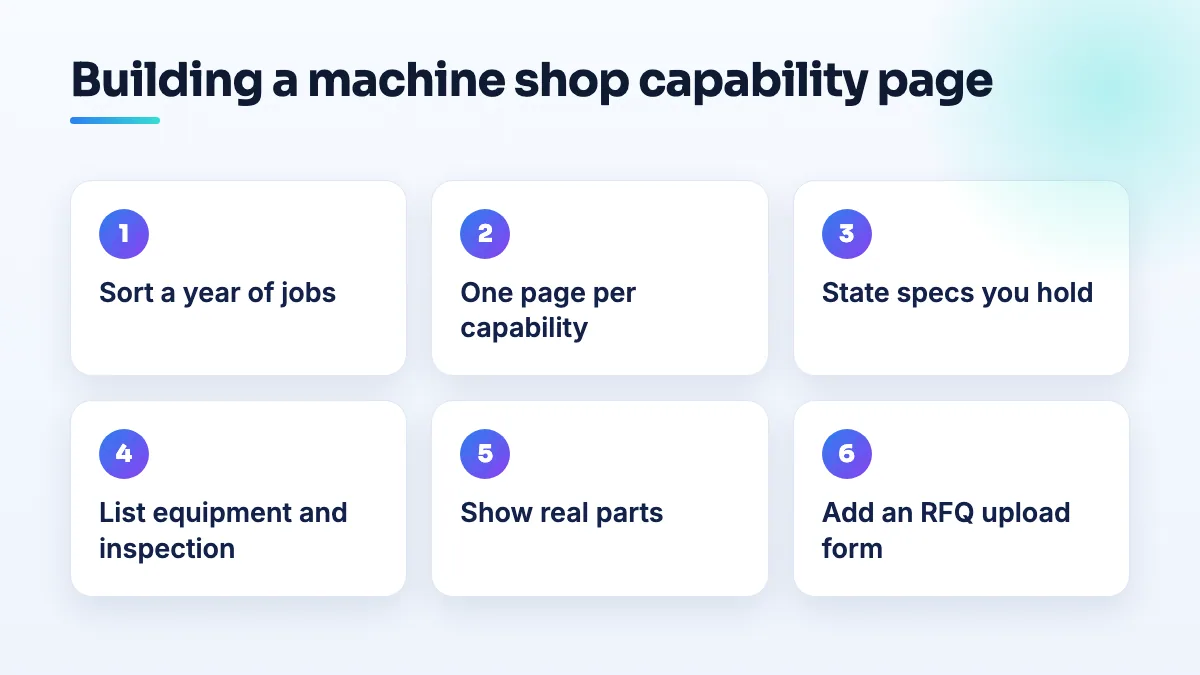
- Pull the last twelve months of jobs and sort them. Group by process, material and finish. Mark the groups with the best margin and the ones you'd happily do more of. Each marked group is a page. Five to ten pages is a good first set.
- Give each capability its own page with a plain title. "Titanium CNC machining" or "Low-volume sheet metal fabrication", not "Solutions." Put the capability and your city or region in the first line, because buyers close by like knowing they can visit.
- State the specs you actually hold. The tolerance you hold routinely and the tighter one you hold with extra inspection, the part size range, the materials you keep in stock, and the quantities you're set up for. Only publish numbers you'd stand behind on a print. Engineers check.
- List the equipment and inspection that make it possible. Machine make, axis count and travel for the machines behind that capability, and the inspection equipment you use. This is what separates a real shop from a broker's website.
- Show real parts. Photos of parts you've made with that process or material, with the customer's permission and nothing proprietary visible. A short caption: material, quantity, what was hard about it.
- Explain secondary operations and lead times. Say which finishes, heat treatment or assembly you do in-house and which you manage through partners, and give an honest range for typical lead times.
- End with an RFQ form that takes a drawing. File upload for STEP and PDF, material, quantity and due date. Offer to sign an NDA. The form is where a page turns into a quote.
If you'd rather not write these pages yourself, this is the kind of SEO content writing we do by interviewing the owner or the lead machinist. The specs have to come from the shop floor.
What's different for machine shops and fabrication shops
Machine shops
For CNC work, material and tolerance pages usually carry the most weight, because that's how engineers narrow down a supplier. A page on a difficult material, with what you do to hold tolerance on it, tells an engineer more than any claim about precision. Repeat production is also worth its own page: in my experience a buyer who needs the same part every quarter values a local shop's reliability over a cheaper first order from overseas.
Fabrication shops
Fab buyers often search by the product or structure rather than the process: skids, frames, enclosures, railings, brackets. Build pages around the things you make as well as the processes. Include size and weight limits, what you can lift and move, whether you install, and how far you deliver, because those decide whether you can take the job at all. A fab shop that wants industrial SEO to bring bigger contracts needs those limits stated plainly.
How capability pages help you avoid price fights
A buyer who finds you through a specific capability page already knows you do their kind of work. That's a different conversation from a buyer who sent the same print to every shop on a list and a marketplace. You'll still lose some jobs on price. But you'll quote fewer jobs that were only ever going to the cheapest bidder, and more where lead time, communication and getting it right the first time are worth paying for.
It also helps with a question owners ask in a Practical Machinist thread on which job titles award manufacturing contracts: who do you even market to? With capability pages you don't have to guess the job title. The engineer, the buyer and the purchasing manager all search for the part.
What not to do
- Don't list every material and process you've ever touched. A page per capability you actually want beats a long list that makes you look like everyone else.
- Don't publish specs you can't hold every time. One failed first article costs more than the page earns.
- Don't build city pages with the town name swapped. Industrial buyers search by capability. One capability page with your region written in beats twenty copies.
- Don't claim an industry you haven't served or a certification you don't hold. Buyers in regulated industries check.
- Don't hide the RFQ form behind a "contact us" page. Put it on every capability page.
Where to go from here
Capability pages only work if the rest of the site passes a buyer's credibility check. I cover what they look at in the guide to the machine shop website buyers trust. If you'd like the pages planned and written for you, that's what our SEO for B2B companies is built around.
Written by Saifur Rifat, Founder & SEO Lead at SERP Squad.