


Key points
- Google rates out of five, Booking.com out of ten
- Google accepts reviews from anyone who interacted with you
- Booking.com asks every guest; Google gets volunteers
- Ask every departing guest for a Google review
- Never offer discounts or upgrades for reviews
Your hotel shows one score on Google and a very different one on Booking.com, and guests ask which one is true. The gap in your hotel Google rating vs Booking.com comes from different scales, different reviewers and different ways of asking, so the two numbers can't be compared directly. The one I'd work on is Google's, because it sits right next to your own booking link.
Here's why the numbers disagree, which one guests actually check, and what raises the Google score without breaking Google's rules.
Hotel Google rating vs Booking.com: why the numbers differ
Travelers notice the gap. In a TravelHacks thread comparing hotel scores across sites, one property was sitting at 3.7 on Google and 5.9 on Booking.com. Those two numbers look like they contradict each other. They mostly don't. There are three reasons.
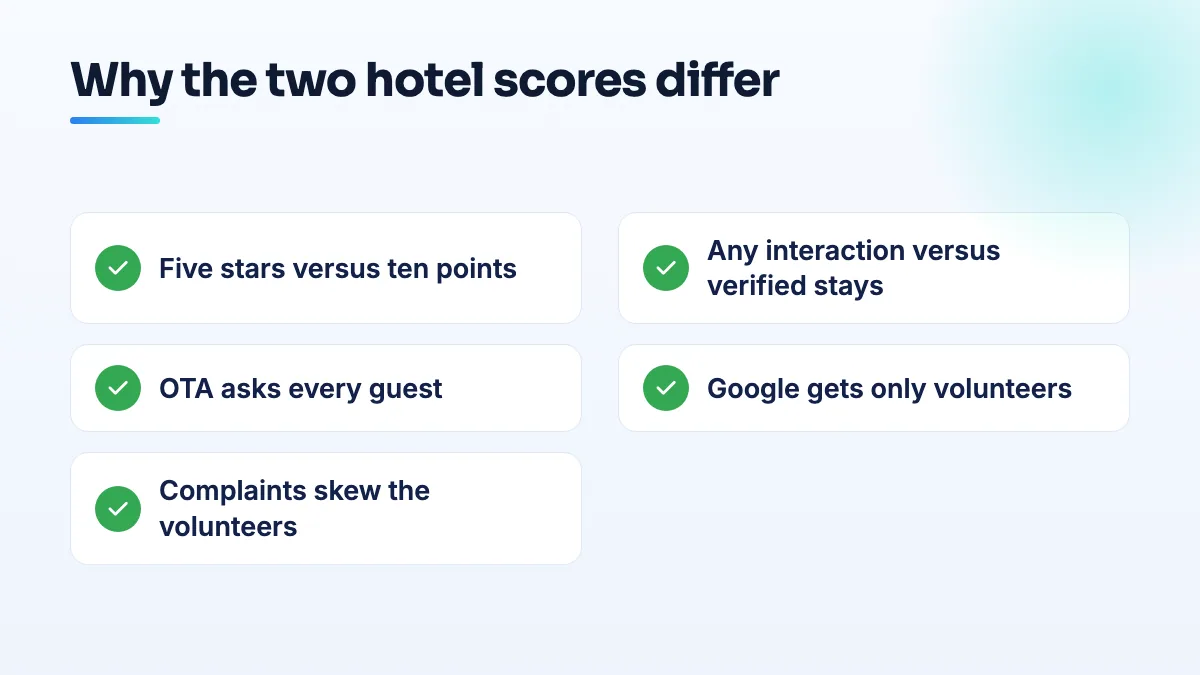
The scales are different. Google uses one to five stars. Booking.com scores out of ten. A 3.7 out of 5 is 74 percent of the scale; a 5.9 out of 10 is 59 percent. In that example Google was actually the kinder score, even though 5.9 looks bigger.
The reviewers are different. Booking.com collects reviews from guests who booked and stayed through Booking.com. Google doesn't require a stay. Mike Blumenthal, a Diamond Product Expert, put it plainly in a Help Community thread about a review from a non-customer: Google does not require "that the reviewer is a customer, only that they have interacted with your business." For a hotel that can mean restaurant diners, wedding guests, someone who used your parking or someone who called and didn't like the rate.
The asking is different. Booking.com asks its guests for a review after checkout. On Google, most hotels never ask at all, so the reviews come from whoever felt strongly enough to go looking. In my experience that skews toward people with a complaint.
Which score guests actually check
Both, and Google more than hotels expect. In a travel subreddit thread about hotel locations, travelers said they cross-check Google Maps because pins on booking sites aren't always where the hotel really is. That puts your Google profile, and its rating, in front of guests who found you somewhere else.
It's also where direct bookings happen. In a travel thread about booking hotels direct, the advice to properties was to invest in Google reviews specifically for that reason. The OTA score helps you sell rooms through the OTA, and hoteliers in an askhotels thread on Booking.com fees put that commission at 13 to 25 percent before Genius and Preferred Partner extras. The Google score helps the guest who's deciding whether to book with you instead.
How to improve your hotel's Google rating
- Read your last 50 Google reviews and tag every complaint. Noise, cleanliness, check-in, parking, price. This is where I start with any hotel profile, and one or two themes usually account for most of the low scores.
- Separate the non-guests. Diners, event guests and callers can review you under Google's interaction rule, so most of those reviews will stay. Reply politely and move on; report only the ones that break Google's policy, such as spam or off-topic content.
- Ask every departing guest, not just the happy ones. A card at checkout with a QR code to your Google review link, a line in the post-stay email and a quick word from the front desk. This is the step I care about most, because it brings in the quiet, satisfied majority who would never have gone looking for the review box.
- Offer nothing in return. Google's policy on user contributions doesn't allow incentives, so no discounts, upgrades or free breakfast for a review. Staff and owners shouldn't review the property either.
- Reply to every review, especially the bad ones. Say what you changed. Future guests read the replies as closely as the reviews.
- Fix the recurring complaint, then watch the next month. If the new reviews stop mentioning it, the fix worked. If they don't, the problem is operational and no review routine will outrun it.
What not to do
- Don't try to match the two numbers. They measure different things, and I wouldn't spend a minute trying to close the gap between them. Aim to lift Google's score and keep the OTA score healthy, separately.
- Don't ask OTA guests to paste their Booking.com review into Google. Ask them to review their stay on Google in their own words, the same as any guest.
- Don't promise "book direct and save" unless it's true. In an askhotels thread on direct booking prices, the consensus was that direct rates are often higher. A broken promise turns into exactly the review you're trying to avoid.
- Don't buy reviews or use a review service that posts for you. A burst of reviews from accounts with no history is easy to spot and can be removed in bulk.
When the Google score is low for a reason you can't fix
Some properties get dragged down by things outside the rooms: an on-site bar that isn't yours, a shared parking lot, a busy road. Reply calmly to each review that mentions it and explain what guests should expect. Setting honest expectations on your website and profile photos cuts those complaints before they're written.
If you're working on moving guests from OTAs to direct, start with the real Booking.com commission cost so you know what each direct booking is worth, and read why Google reviews matter for your map ranking. Reviews and the booking link are the core of our hotel SEO work, and if you'd like the profile itself handled, that's our Google Business Profile management.
People also ask
Why can't I edit my hotel's description on Google?
Because on hotel profiles the About summary is written by Google from its own sources, not from a description you submit, so there's no box to rewrite it. You can still control the name, contact details, website, category, amenities, photos, booking links and review replies, and you can correct wrong facts through suggested edits and by making your website and OTA descriptions say the same thing.
Read the full answer: Why can't I edit my hotel's description on Google? →
Can an agency's restricted Google account get my profile suspended?
Yes. If an agency, freelancer or vendor with access to your listing has its Google account restricted, Google can suspend every profile connected to that account, and yours goes with it. The notice says a Google account associated with the profile was restricted. Proving your address won't fix it: remove the account, have the agency resolve its restriction, and appeal on that point.
Read the full answer: Can an agency's restricted Google account get my profile suspended? →
Can you appeal a Google review decision more than once?
No. You get one appeal on each review Google decides not to remove, and once the appeal is denied, that decision is final for that review. Wait for the first decision before appealing, and only appeal with new evidence tied to a specific policy clause. After that, your options are a calm public reply, reporting new reviews from the same accounts, and outnumbering the review with genuine ones.
Read the full answer: Can you appeal a Google review decision more than once? →
How do you ask a B2B buyer for a Google review?
Ask one named person who saw the job go well, such as the engineer whose first article passed or the manager who watched your sign go up, within a day or two of the job. Ask in person first, then send a short email with your direct review link. Tell them they don't need to mention part numbers or their company, and never offer anything in return.
Read the full answer: How do you ask a B2B buyer for a Google review? →
Can a booth renter get their own Google Business Profile?
Usually not at the salon's address. Google only lets a business in a shared space list that address if it has its own dedicated space with permanent signage, where customers deal with its own staff during business hours. An open-floor chair doesn't pass that test. A private suite with your name on the door can, and a renter who also travels to clients can list as a service-area business with the home address hidden.
Read the full answer: Can a booth renter get their own Google Business Profile? →