


Key points
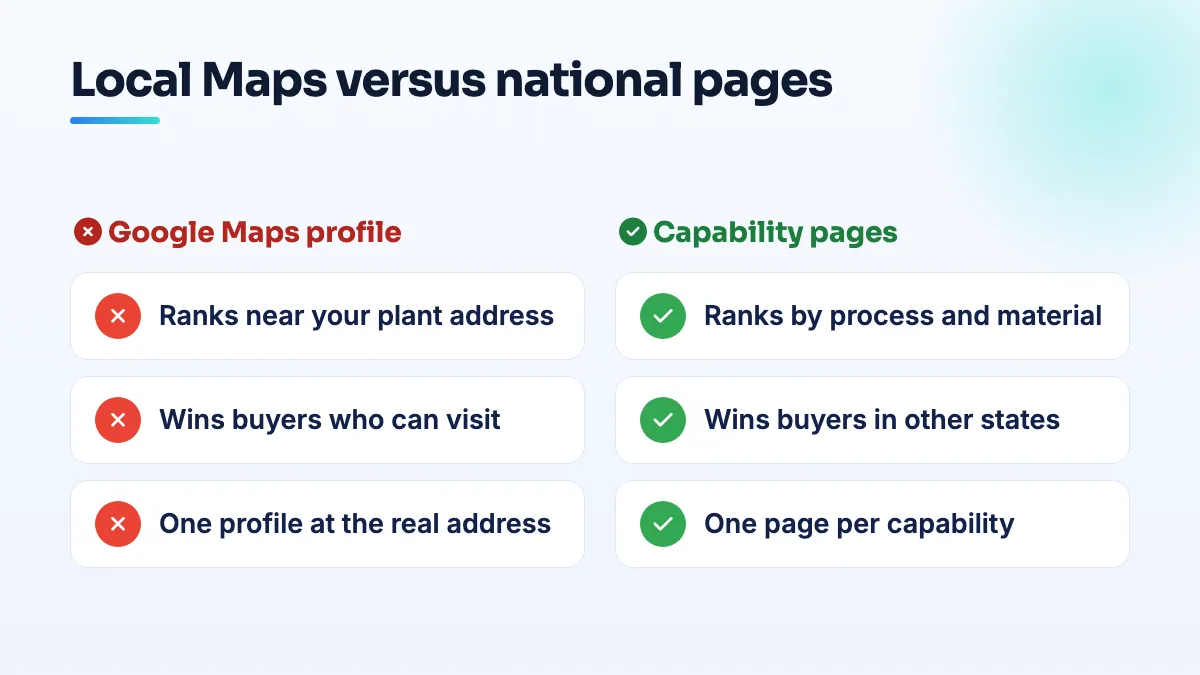
- Maps ranks you near your plant, not nationwide
- A bigger service area doesn't widen your rankings
- Buyers in other states find capability pages
- Keep one profile and one set of reviews
- If nobody visits, you may not be eligible
If you ship parts to every state, it's fair to ask whether local SEO for manufacturers is worth any of your time. My answer is yes for the customers near your plant, and no for the national work, which comes from a different set of pages. The mistake I see is trying to make one tool do both jobs.
Here's what each one does, how I'd set them up so they don't get in each other's way, and the edge case where Google won't give a plant a listing at all.
Why local search still matters for a shop that ships everywhere
When I went through what machinists say about marketing, one discussion stood out. In a Practical Machinist thread about Google Ads for job shops, owners called search pointless because they already rank for their own name, and in the same thread other shop owners said Google Maps was genuinely useful to them.
Both things are true, and they aren't in conflict. Ranking for your own company name only reaches people who already know you. Maps reaches the engineer twenty minutes away who has never heard of you and needs a shop they can drive to. Those nearby buyers are often the best ones: they want to walk the floor before they send a print, pick up first articles, bring a fixture back for rework or get a rush job done without paying freight. None of them search for your name. They search for the process and the place.
What local SEO for manufacturers can and can't do
Most of the confusion comes from the service-area setting. In a Reddit discussion about local SEO for a nationwide service area, the question of whether local SEO does anything for a business that serves the whole country never really got an answer. The clearest one I found came from another industry. In a Local Search Forum thread about a transport company serving all of North America, the forum admin wrote that "the service area has zero impact on where you rank." Ranking follows the address you verified, and he advised keeping the service area within about two hours of it.
So your profile will never put you in the map results of a city 900 miles away, whatever you type into the service area. What it can do is show you for "machine shop", "metal fabrication", "powder coating" and similar searches from people near the plant.
National visibility is a website job. Buyers in other states search for a process plus a material, a tolerance, a certification or an industry, and they land on the page that describes exactly that. That's the core of national SEO for a manufacturer, and it doesn't compete with your Maps listing at all.
How to set up Maps and national pages without conflict
- Check you're eligible before you create anything. Google's Business Profile eligibility rules only cover a business with a location customers can visit, or one that travels to customers in person. If buyers, drivers or walk-in customers come to your door during the hours you list, show the address. If nobody ever visits, read the section on verification below first.
- Keep one profile, at the real plant address. Pick the primary category that matches the work you most want, then add secondary categories for your other processes. Don't add a service area covering the whole country. It won't help you rank, and it makes the listing look like something it isn't.
- Build one page per capability on your website. Every process, material and finish you want to sell nationally gets its own page with your equipment, the tolerances you'll commit to, part photos and certifications. I explain what goes on a machine shop capability page in a separate guide.
- Say both things on the homepage. A line like "Precision machining in your town, shipping nationwide" with your street address in the footer tells Google and the buyer that the local shop and the national supplier are the same business.
- Point the profile's website link at your homepage or a page about the plant. The person who found you on Maps wants to know they can visit, what you run and who to call, not a page written for an out-of-state buyer.
- Skip city pages for places you have no presence. A "CNC machining Dallas" page for a shop in Ohio is thin and usually goes nowhere. Target the process and the industry instead. I cover when a city page can work in the answer on whether you can rank in a city without an office.
One set of reviews or two?
A company that ships nationally and also sells locally asked in a Reddit thread about shipping nationally while selling locally whether reviews from the two customer groups would conflict. They don't. Reviews belong to the business, and it's one business.
My advice is to ask local customers for Google reviews on the profile, because that's where nearby buyers read them. For national buyers, put named testimonials and short project write-ups on the capability pages they arrive through. Never create a second profile to hold "national" reviews. Google treats that as a duplicate listing.
When Google won't verify a plant nobody visits
This is the edge case that catches manufacturers most. In the Google Business Profile Help Community there's a Help Community thread about verification failing for premises customers never visit, a thread where the chosen category required a location customers can visit, and a verification video thread asking for street signage and branded equipment that a unit in an industrial park simply doesn't have.
If nobody comes to your plant and you never go to customers, you may not be eligible, and forcing a profile through risks a suspension. In that case I'd skip it and put the effort into the website. If buyers do visit, put a permanent sign with your business name at the entrance, make sure the profile name matches that sign exactly, and if Google asks for a video, film the sign, the entrance, you opening a door with your own key, and the machines inside.
How I'd split the effort
For most shops that ship nationwide, I'd set up the Maps profile properly once, keep the hours and photos current, and spend the ongoing time on capability pages. If a big share of your best customers are within an hour's drive, I'd weight it the other way and treat the profile as your main channel. Either way, it's the same split I use in manufacturing SEO and machine shop SEO projects: local for the plant, pages for the country.
People also ask
Is AS9100 certification worth it, and does it help a machine shop get found?
Only if buyers you want already ask for it. Owners report around $10,000 and eight months for AS9100, and it won't rank a shop by itself. It helps when aerospace, medical or defense buyers filter on it, and only if you publish it clearly: a certification page with scope and expiry, and a mention on every relevant capability page.
Read the full answer: Is AS9100 certification worth it, and does it help a machine shop get found? →
How do you ask a B2B buyer for a Google review?
Ask one named person who saw the job go well, such as the engineer whose first article passed or the manager who watched your sign go up, within a day or two of the job. Ask in person first, then send a short email with your direct review link. Tell them they don't need to mention part numbers or their company, and never offer anything in return.
Read the full answer: How do you ask a B2B buyer for a Google review? →
How do you claim a Google listing that has no claim button?
Start from Business Profile Manager instead of the listing. Add a business, pick your existing listing from the suggestions, and Google will either let you verify it or route you to its ownership request, which emails the current owner. If neither appears, check every Google account you've used, then post the Maps link in the Help Community so a Product Expert can look.
Read the full answer: How do you claim a Google listing that has no claim button? →
What should you do when no Google Business Profile category fits your business?
Choose the closest category that describes the work customers hire you for, based on the categories the top three businesses use for your main search. Check it doesn't require a storefront you don't have. Then describe your exact specialism everywhere Google allows your own words: secondary categories, custom services, the description and a dedicated page on your website. Make the category change once, because category edits can send a profile back into review.
Are service area pages still safe after the August 2026 spam update?
Service area pages that give each town real, specific information are still safe. Pages that only swap the city name into the same text match Google's description of doorway pages and were at risk long before August 2026. Reports of pages dropping after the update are anecdotal and inconsistent, so audit each page: keep the ones with local substance, merge the thin ones into one service-area page, and cut pages for towns you don't serve.
Read the full answer: Are service area pages still safe after the August 2026 spam update? →