
300% organic traffic in 4 months
A Shopify store went from page 3 to category leader with technical and content SEO. Read the Shopify case study →
Paid ads get more expensive every quarter. Organic search compounds. Watch the case study on the right: one store, four months, from page 3 to category leader. The playbook is repeatable, and it starts with your free store audit.
Why store owners buy this
The economics are simple and they favor the early mover:
Every point of rising CPC comes straight out of your margin. Organic traffic keeps selling with no per-click cost, forever.
Category and comparison searches happen before brand searches. The store that owns those keywords gets the customer before your ad even bids.
Duplicate collection URLs, thin product pages, missing schema. Stores that fix them outrank stores that do not, in the same niche, with smaller budgets.
Store beyond saving? Our Shopify website design team rebuilds it with SEO in the templates.
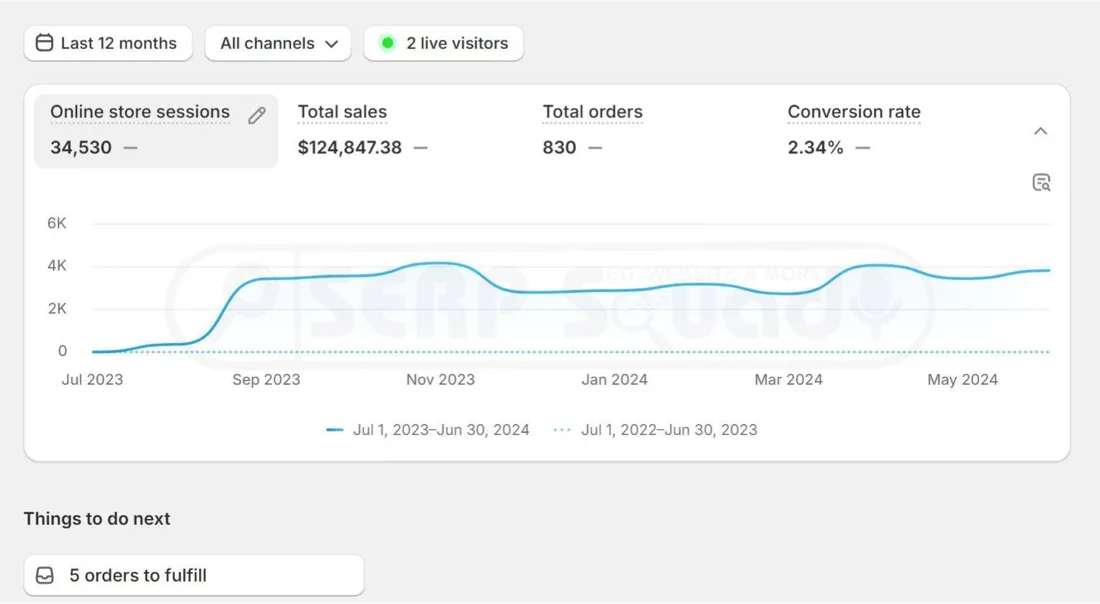
A client store's own Shopify analytics: 34,530 sessions, $124,847.38 in sales and 830 orders in twelve months, from a store that started the year near zero.
Proof, not promises
The full case study plus a client review. The full set lives on our client reviews page and YouTube channel.
A Shopify store went from page 3 to category leader with technical and content SEO. Read the Shopify case study →
A service business owner on what changed after SERP Squad took over.
★★★★★“Finally an SEO team that reports on leads, not just rankings. We can see exactly what we're paying for.”
The first 90 days
The same sequence that produced our 300% case study:
Duplicate URLs canonicalized, collection structure fixed, product schema deployed, speed measured on real phones.
Money collections rewritten around buying keywords, product templates optimized, first content pieces live.
Collection keywords enter page 1, organic sessions climb, and revenue attribution starts showing what search sold.
Content catches shoppers earlier, collections deepen, and the store's organic revenue line keeps bending upward.
Transparent reporting
Store reporting means revenue, not sessions. Three reports, monthly:
What organic search actually sold this month, by collection and product line, straight from your store analytics.
Every money keyword's position with the collection or product page carrying it, so ranking gains map to revenue lines.
Technical fixes shipped, collections optimized, content published and schema updated this month, in plain English.
What works now
Store revenue now arrives from six directions. A Shopify campaign wires your catalog into all of them, and the revenue report proves which ones sell.
Collection and product pages ranking organically are the store's compounding revenue line, selling daily without the rising per-click toll of ads.
Desktop shoppers research bigger purchases on Bing, and it feeds Copilot product answers. A properly indexed Shopify catalog captures those carts.
Stores with retail locations put them on the default iPhone map with Apple Business Connect, connecting online visibility to in-store pickup.
Shoppers ask AI what to buy. Product schema, honest reviews and citable collection content decide whether the assistants recommend your store.
Shoppers check your Instagram before trusting an unknown store. Consistent product presence converts that check into first orders.
Product videos rank in YouTube search where buying decisions form, demonstrate what photos cannot and feed AI shopping answers about your niche.
Every one of these channels is part of our Shopify SEO service; your free store audit shows which sells first.
Honest comparisons
Store growth budgets face the same three pitches. The honest comparison:
Paid social sells at an acquisition cost that climbs every quarter. Collection rankings sell the same products daily with no per-order toll, which is the whole 300% case study on this page.
Amazon brings demand and keeps the customer, the data and a commission. Your ranked store keeps all three. Most healthy brands run both, deliberately, with the store as the asset.
GEO, being cited when shoppers ask AI what to buy, is not a rival discipline. Generative engines lean on the same authority, structure and entity signals strong SEO builds. Product schema and honest reviews are what shopping answers cite.
Service areas
Strategy tuned to how people search in each market. See every market on our service locations page.
Related services
Performance pricing
If a monthly retainer is the wrong shape for your business, pay per result SEO is the alternative. The rate is agreed in writing first, the lead count comes with the recordings behind it, and nothing is invoiced until leads actually exist.
Buyer beware
Ecommerce SEO scams scale with your catalog: a thousand thin pages look like work. What burned stores look like:
The most common scam is the simplest: a retainer collected every month with no work log and no report. If an agency cannot show you exactly what was done in the last 30 days, the honest answer is usually nothing.
Some agencies register your domain, own your hosting and keep your logins, then the site vanishes if you stop paying. Your domain, website and Google Business Profile must be owned by you, always.
Hundreds of auto-generated blog posts feel like activity, but unedited AI content nobody reads produces no leads and can drag the whole site down. Volume is not a strategy; content only counts when it answers real searches.
Nobody controls Google's results, and Google itself says ranking guarantees are the mark of a scam. Real agencies show evidence and timelines; fake ones sell certainty they cannot deliver.
A 12-month contract exists so an agency gets paid whether it performs or not. If the results were real, the contract would not need to trap you, which is why we do not use one.
Thousand-link packages from link farms and PBNs look like progress until Google catches the network, and it is your site that takes the manual action. Recovering costs more than the links ever did.
Ask any agency, us included, for three things before you pay: a sample monthly report, written confirmation that you own your domain, website, hosting and Google Business Profile, and the work log from a current client's last 30 days. We show all three in your free audit call, plus reviews you can verify on Google and Trustpilot. An agency that hesitates on any of them has answered your question.
Yes. Our best documented result is a Shopify store that grew organic traffic 300% in four months. Shopify has quirks, and knowing them is the difference.
Usually duplicate content from collection URL parameters, thin product descriptions, missing schema and slow themes. The audit ranks them by revenue impact for your store.
Yes. When a theme is beyond saving we rebuild it through our Shopify website design service, with SEO in the templates from day one.
Usually, and yes. App scripts are a top Shopify speed cost, so the audit includes an app-impact review: what each app costs in load time versus what it earns. We also use metafields to extend product SEO beyond what themes expose.
Yes. Markets creates per-country URLs that need correct hreflang and localized content to rank. We configure both so your store competes properly in each country it ships to.
Fresh from the desk
What we publish between campaigns. Worth a read if you want to understand how this work actually gets done before you pay anyone to do it.
We check the technical issues Shopify is known for, your collection and product optimization, and the content gaps between you and the stores outranking you.