

Most small hotels know their Booking.com commission rate and have never added up what it costs in a year once Preferred Partner and Genius are on top. The Booking.com commission cost is usually far more than the headline percentage suggests. The answer isn't to leave the OTAs. It's to know the real number, then make booking direct genuinely better so the guests who already know your name stop paying Booking.com to reach you.
This is for independent hotels, motels, inns and B&Bs. Below is what the bill is made of, a worksheet to calculate yours, why "book direct and save" is often not true, and the order I'd fix it in.
What Booking.com commission cost is made of
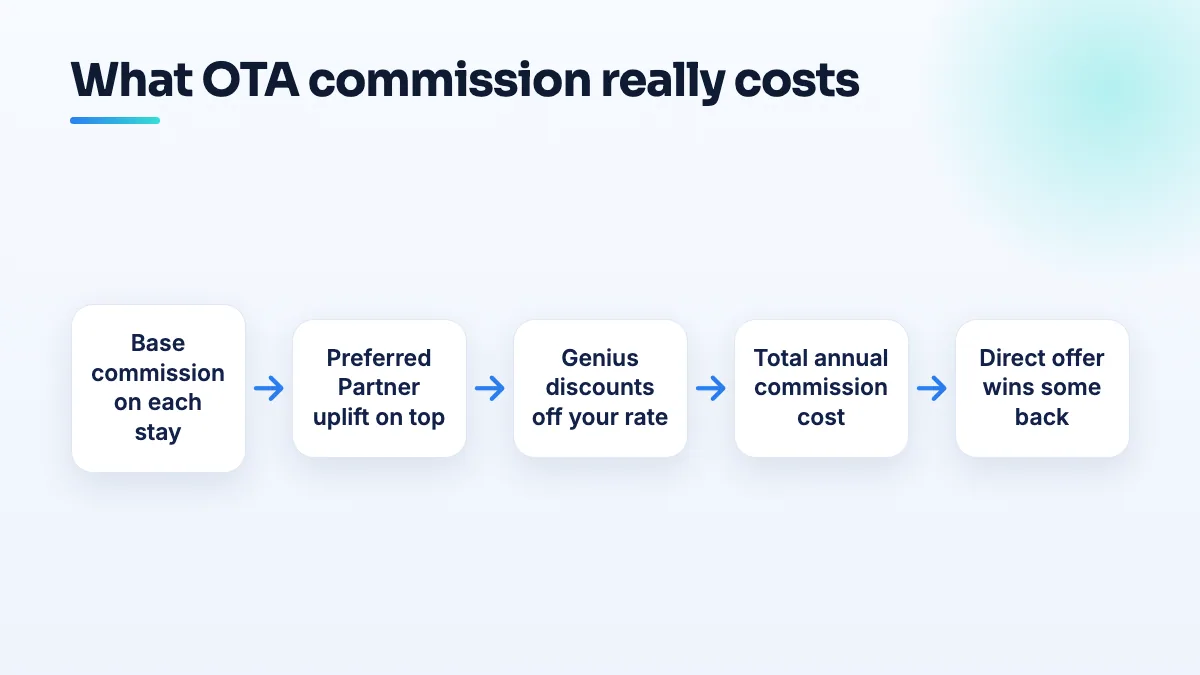
Hoteliers in a Reddit discussion among hotel managers about Booking.com fees put the base commission at 13 to 25 percent, with Preferred Partner and Genius costs on top. Those extras are where most owners lose track:
- Base commission is the rate in your contract, charged on each stay.
- Preferred Partner raises that rate in exchange for better visibility in Booking.com's results.
- Genius is a discount you give Booking.com's loyalty members. It doesn't show up as commission. It comes off your room rate, so it's easy to miss when you add up the fees.
Other OTAs work differently in the detail, but the pattern of a base rate plus paid programs on top is common, which is why I work out OTA commission for hotels per channel rather than using one blended guess.
How to calculate your annual Booking.com commission cost
Pull last year's statements and fill in this worksheet. The example column uses round numbers for an imaginary property so you can see how it adds up. They aren't figures from any real hotel; replace them with yours.
| Line | How to work it out | Example |
|---|---|---|
| Room revenue booked through Booking.com | From your extranet or channel manager, for 12 months | $100,000 |
| Base commission | Revenue × your contract rate | 15% = $15,000 |
| Preferred Partner uplift | Revenue × the extra percentage points | 3 points = $3,000 |
| Genius discounts | Revenue from Genius bookings × the discount you give | $50,000 × 10% = $5,000 |
| Total cost for the year | Add the three lines | $23,000, or 23% of that revenue |
- Get 12 months of Booking.com revenue from your extranet or channel manager, not an estimate.
- Apply your actual contract rate, not the rate you remember signing years ago. Rates change when programs are added.
- Add every program you're in, including ones a previous manager switched on.
- Count the Genius discount as a cost, because that money never reaches you.
- Divide the total by the revenue to get your real rate, and repeat it for every other OTA.
I always keep the Genius line separate, because it never appears on an invoice and it's the one owners leave out. The number that matters most, though, is the share paid by guests who would have found you anyway: repeat guests, locals, people who searched your hotel's name. They're the ones you can win back.
Why "book direct and save" often isn't true
Plenty of hotel websites say "book direct and save", and guests check. In a Reddit thread where travelers and hoteliers compare direct and OTA prices, people say the direct rate is usually 10 to 25 percent higher than on the OTAs. A guest who sees a cheaper price on Booking.com right after reading "save" on your site doesn't just book there. They stop trusting your site. I'd fix that before I spent a cent promoting the website.
In my experience it comes down to a few things: OTA-funded discounts and Genius rates the hotel forgets are live, loyalty-member prices on the OTA, and contracts that limit what you can publicly show. Check your contract before you change public rates, because rate terms vary.
How to make book direct and save true
- Search your own hotel like a guest on a phone, signed out, for three dates next month. Write down the price on your site and on each OTA. That's your honest starting point.
- Give direct guests something the OTA doesn't show. If you can't beat the public price, add value instead: breakfast, free parking, a late checkout, a room upgrade when available, or more flexible cancellation. Put it next to the price, not in the small print.
- Say exactly what the saving is. "Book direct: breakfast included and free late checkout" is believable. A vague "best rate guaranteed" that a guest can disprove in ten seconds isn't.
- Make the booking engine work on a phone. If booking direct takes more taps than the OTA, the OTA wins on convenience alone. Test it yourself on a phone from start to confirmation. Owners in a Reddit thread asking whether a paid booking engine shifts direct bookings couldn't say whether theirs made a difference, so judge any engine by how it books on a phone, not by its sales pitch.
- Keep the guests you already paid for. A guest who came through an OTA once can come back direct next time. Collect emails at check-in where your local rules allow it, and send returning guests a direct offer.
Hoteliers asking on Reddit how to escape OTA commission is a thread that comes up again and again. My answer is always the same: you don't cut the OTAs off, you stop giving them the bookings that were already yours.
Win the guests who search your hotel's name
The easiest bookings to move are from people who already typed your hotel's name into Google. On that search, your own profile competes with OTA links, so the setup of your profile matters as much as your website.
- Put your direct rate on Google. Google free booking links let your own rate appear beside the OTAs on your brand search.
- Fix OTA content on your profile. In a Help Community thread about OTA photos on a hotel's profile, a hotel found OTA photos on its profile that sent guests to the OTA. Upload your own photos and report the ones that aren't yours.
- Work on your Google reviews. Travelers advising hotels to invest in Google reviews for direct bookings make the case for exactly that, because guests look at your Google rating before they book. If your Google score lags behind your OTA score, read why a hotel Google rating differs from Booking.com.
How to tell whether it's working
Owners of small properties often ask what a "good" direct share is, and there's no reliable benchmark; boutique hotel owners comparing their direct booking share have nothing reliable to measure against. So compare yourself with yourself. I keep it to three numbers, recorded once a month: direct bookings, OTA bookings and total commission paid. Then watch the trend across a full year so seasons don't fool you.
What not to do
- Don't drop the OTAs cold. I'd never advise it for a small property. They bring guests who have never heard of you. The goal is to reduce OTA dependence, not to empty your rooms.
- Don't promise the lowest price unless you've checked it on every channel, on the dates guests actually book.
- Don't buy ads on your own hotel name before your free booking links and profile are set up. Fix the free parts first.
- Don't join another OTA program without running it through the worksheet above.
Next step
Direct bookings come from three things working together: a profile that shows your rate, a website that books on a phone, and a reason to book direct. That's what we build in hotel SEO projects, and if your booking path is the weak link, a small business website rebuild is usually cheaper than a year of commission on the bookings it loses. If your Google profile is the problem, that's Google Business Profile management.
Written by Saifur Rifat, Founder & SEO Lead at SERP Squad.