

You search for the service you sell in your own city and page one is Justia, SmartAsset, The Knot, Lessons.com or Psychology Today, with your firm somewhere below all of them. You can compete with directories in search, but not by trying to outrank them for "best lawyer in Columbus". You win the map pack, your own name, and the specific searches a directory's list page can't answer, and you use the directories that rank as one more place to be found.
This hits lawyers and financial advisors hardest, and therapists, driving schools, wedding photographers, event planners, testing labs and startups in almost the same way. I checked the results for several of these industries directly, and the pattern was the same each time.
What page one actually looks like
These are searches I ran while researching this post, and what sat above the independent businesses:
| Search | What ranked first |
|---|---|
| best personal injury lawyer Columbus Ohio | Positions 1 to 5: Justia, Super Lawyers twice, Yelp and a curated list article. Firm websites came after all of them. |
| financial advisor near me Charlotte NC | A bank, Wealthtender, a SmartAsset "Top 10", PlannerSearch, a large firm's directory, Yelp and Expertise.com. One independent firm site in the top nine. |
| wedding photographer Asheville NC | The Knot first, WeddingWire second, a Facebook page third, then individual photographers. |
| driving lessons Sacramento CA | A funded national chain in positions 1 and 3, with Lessons.com, YellowPages and Yelp above long-standing local schools. |
| homes for sale Naperville IL | Portals and brokerage brands for all ten results. No individual agent. |
The national chain in the driving search is Coastline Academy, which describes its growth through technology and acquisitions. Therapists say the same thing about Psychology Today for "therapist near me" searches.
Why directories win these searches
"Best personal injury lawyer" and "financial advisor near me" are comparison searches. The person wants options, and a list of ten firms with ratings answers that better than any single firm's homepage can. Directories also have thousands of pages, years of links and a page for every city, which no independent practice will match.
So I don't spend a client's money trying to push their homepage above Justia for a list query. That's a fight about what the searcher wants, and the directory is giving it to them. The work goes where the searcher wants one business, or wants something a list can't give.
Where to compete with directories in search
- The map pack. The three business listings on the map show businesses, not directories. For most local searches this is the most valuable spot on the page, and your competition there is other firms, not Justia.
- Your own name. People who hear about you search your name. Directories often rank for it too. Your site and your profile should own that search outright.
- Specific service and situation searches. "Contested divorce with a family business", "fee-only advisor for retiring teachers", "driving lessons with home pickup for nervous adults". A directory's category page for your city is too generic to answer those well.
- The questions people ask before they hire. What it costs, how long it takes, what happens first, what to bring. A directory lists you. It doesn't answer what your clients ask you in the first ten minutes.
How to find your winnable searches, step by step
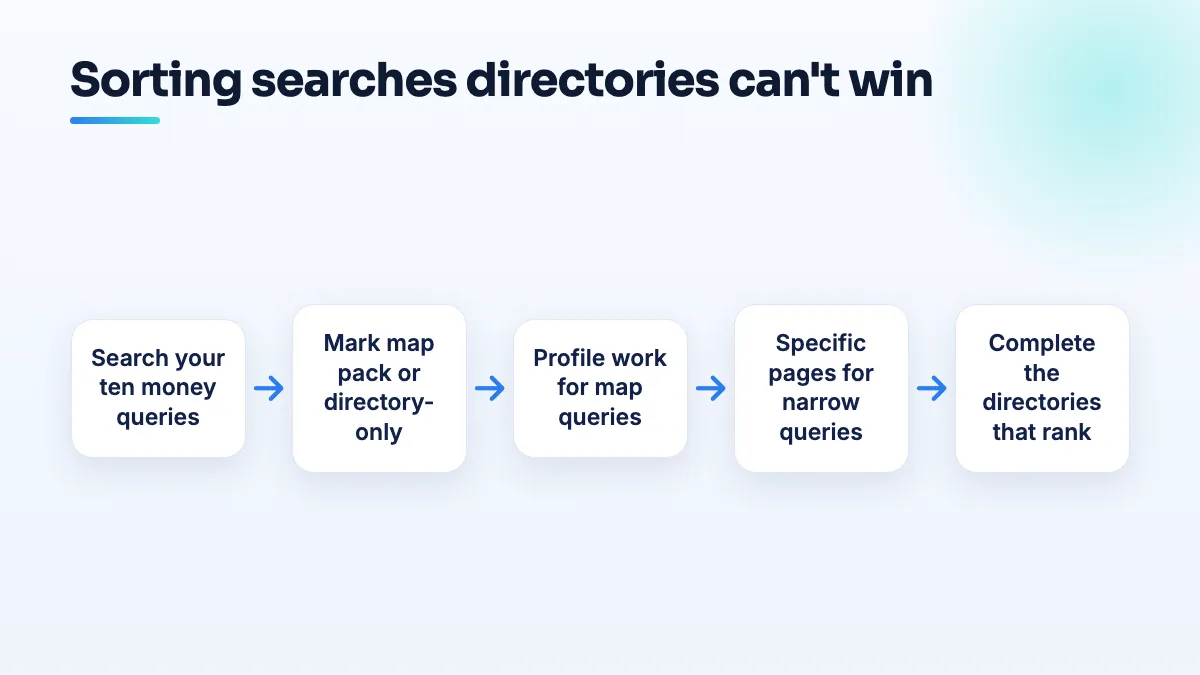
- Write down your ten money searches. The phrases a client would type just before hiring someone like you, each with your city or "near me". Search each from your office area and save a dated screenshot.
- Mark each one map pack, directory-only, or open. Map pack means business listings show above or among the results. Directory-only means lists fill the first page. Open means individual businesses already rank on page one.
- Point your profile work at the map pack searches. Primary category, services, reviews, photos and a link to the most relevant page on your site. That's where you're only competing with other businesses.
- Build one strong page for each open or specific search. Not a city page with the name swapped. A page that answers the specific situation better than anyone: who it's for, how you handle it, what it costs or how pricing works, and who at your firm does it.
- Complete your profile on the directories that rank for directory-only searches. If The Knot or Justia is where searchers land, you want to be one of the listings they compare. Use exactly the same name, address and phone as your Google profile. That consistency is what local citations are about.
- Track where calls and inquiries came from. Ask every new client, use tracked numbers where the directory allows it, and check after 90 days which directories actually produced work. Drop the ones that didn't.
Law firms: Justia and Super Lawyers own the list searches
For law, the specific searches are practice area plus situation plus place, and that's where firm sites still rank. One detail I use often comes from Joy Hawkins in a Local Search Forum discussion on attorney practitioner listings: a family-law attorney's listing should link to the family law page, not the homepage. That ties the map listing to the page built for the search. She also warns that a firm splitting into several attorney listings needs almost twice as many reviews for that setup to work.
Watch the language you borrow from directories. The ABA's comment on Model Rule 7.1 says truthful past results can still mislead if they create an unjustified expectation, and Rule 7.2(c) allows a "specialist" claim only with certification from a named, approved body. A directory can call you "best". Your own page usually can't. Check your state's version before publishing. It's part of how I approach law firm SEO: compete on specifics, not superlatives.
Financial advisors: SmartAsset and the "near me" problem
With one independent firm in the top nine for "financial advisor near me", the generic search is close to closed. Advisors win on specialty and on the map: who you serve, what you charge, and a profile that follows Google's naming rules. Google's guidelines name financial planners as individual practitioners, and a solo advisor at a branded firm uses a "Brand: Name" format, with Google's own example being "Allstate: Joe Miller".
Be careful with directory badges. The SEC's announcement of the Marketing Rule says third-party ratings can't be used in an advertisement unless the adviser provides disclosures and the rating meets certain criteria. A "Top 10 advisors" badge from a lead-generation site, pasted on your homepage, is a compliance question before it's a marketing asset. If you're affiliated with a broker-dealer, plan content around principal approval, because a page that waits two weeks for sign-off still beats one that never ships. More on this in financial advisor SEO.
What's different in other industries
- Therapists. A Psychology Today profile is where many clients start, so keep it complete and current. Your own site wins on modality and population: "EMDR for first responders", "couples therapy for new parents". That's the core of therapist SEO for a small practice.
- Wedding photographers and planners. The Knot and WeddingWire hold the top two spots and are one company, so listing on both isn't spreading your risk. Whether that listing pays is its own question, covered in is WeddingWire worth it. Your site wins on venues and styles: named venues you've shot or planned at, with real galleries.
- Driving schools. Aggregator "10 best" pages and a funded chain sit above local schools. Local schools win on neighborhoods, pickup areas, test routes and instructor names.
- Startups. Many can't have a Google Business Profile at all, because a Product Expert guide on business addresses makes clear that virtual offices and unstaffed coworking desks don't qualify. That leaves the website and the narrow searches as the whole plan.
- Testing labs. Buyers often don't know the right term. Pages built on the exact test names people use can rank where generic directory pages don't.
- Real estate agents. Portals take every result for listing searches, and the answer is similar. I cover how a real estate agent can rank beyond Zillow separately.
What not to do
- Don't publish your own "best firms in town" list with you at number one. Readers see through it, and it's the kind of self-serving page that erodes trust.
- Don't create city pages for every suburb with the name swapped. Directories already have those pages, and yours will be thinner.
- Don't open virtual offices to appear in more cities. It's against Google's address rules and puts your real listing at risk.
- Don't pay every directory by default. Pay the ones that rank for your searches and produce tracked inquiries. Wedding vendors report year-long contracts and WeddingWire's Trustpilot page scores it 1.4 out of 5, so check the terms before you commit.
Where to start
Do the ten-search exercise this week. Most practices find two or three map pack searches they're close to winning and several specific searches with no strong page at all. Our local SEO services handle the map side, and the specific pages are what our SEO content writing is for.
Written by Saifur Rifat, Founder & SEO Lead at SERP Squad.