

Most drug testing and fingerprinting businesses get work by calling HR departments and schools, while the people who actually choose a testing site are searching Google for one. Drug testing collection site marketing works when you stop describing yourself as "a testing company" and build a page and a profile detail for each thing an employer, school or applicant searches for: DOT testing, pre-employment screens, live scan, ink cards, mobile collection.
The buyer usually has a specific need and a deadline. An HR manager needs a pre-employment screen done by Friday. A trucking company needs a DOT collection after an accident. A nursing student needs fingerprints for a clinical placement. Each of them searches for their exact need, and each checks whether your site says, in plain words, that you do it.
Here's where operators go wrong, the pages and profile details that win those calls, and what to change first.
Why testing sites miss the employers already searching
Three patterns show up again and again when operators talk about this business in public.
- Cold outreach is the default. In a Reddit thread from mobile fingerprinting and signing operators about finding clients, the advice centers on calling institutions directly. Outreach works, but it's slow and it ignores buyers who are already looking.
- Nobody's sure how customers arrive. In a small business thread asking how testing sites get customers, would-be operators ask how this business actually finds its customers. If you don't know, you can't invest in it.
- The ones who do know point to the Google profile. Mobile operators in a Reddit thread where mobile operators discuss where their clients come from describe the Google profile as their main source of new customers.
Buyers add their own problem. In a Reddit thread where applicants ask whether they need live scan or fingerprint cards, people didn't know which of live scan, an FD-258 card or ink prints they needed, so they searched for all of them. A site that only says "fingerprinting services" misses most of those searches.
My own proof that this category rewards the work is our IDENTICO fingerprinting case study, where the average map rank across Miami went from 12.37 to 1.16.
What an employer needs to see in the first ten seconds
An HR or safety manager is not browsing. They open two or three sites and look for the same few facts. Put these near the top of every relevant page:
- The exact test names you offer: DOT and non-DOT urine collection, breath alcohol, pre-employment panels, random programs, post-accident, reasonable suspicion.
- Walk-in or appointment, and your hours. Including early mornings and Saturdays if you do them, because shift workers can't come at 2 p.m.
- How results are delivered and roughly how long it takes, in the terms you can honestly commit to.
- How to set up an employer account: billing, who authorizes a test, how the donor gets their paperwork.
- Whether you come to them. On-site or mobile collection for a crew, a fleet yard or a school.
- A phone number answered by a person during your hours.
Drug testing collection site marketing, step by step
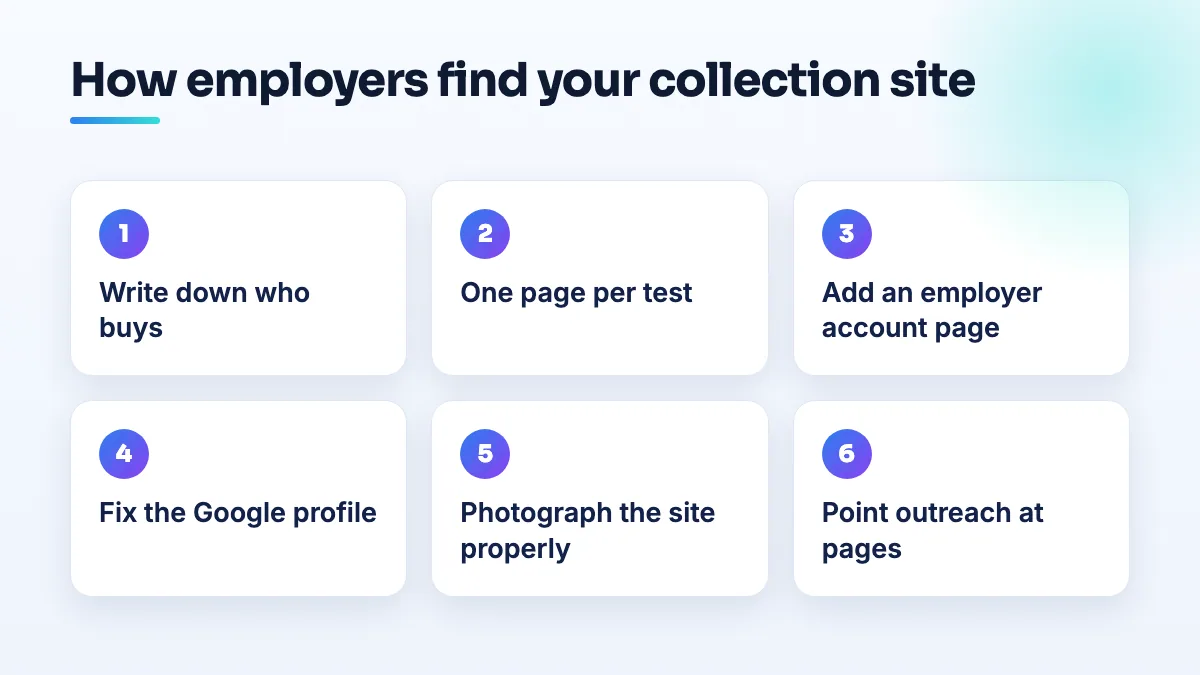
- Write down who buys from you. Employers (HR and safety), DOT-regulated fleets, schools and training programs, third-party administrators, and individuals who need fingerprints or a test for themselves. Next to each, note what they search for. That list becomes your page list.
- Build one page per test type, not one "services" page. A DOT drug testing page, a pre-employment testing page, a live scan fingerprinting page, an ink card and FD-258 page, a mobile collection page. Each one says who it's for, what the person brings, how long it takes and how to book. I help operators find those exact phrases with local keyword research before a single page is written.
- Add an employer account page. This is the page your outreach emails should link to. Explain account setup, billing, how you handle random selections if you do, and who to call. A buyer who can set up an account without a sales call often will.
- Set up the Google profile for how you really operate. If donors come to your site, list the address with accurate hours and the right primary category. If you're purely mobile, you're a service-area business: hide the address and list only the areas you actually drive to. Mobile collectors with no premises run into the same address problem home-based practitioners do, as a Reddit thread about healthcare providers without a public address shows. Add every test type to the services list, using the same names as your pages.
- Photograph the site properly. Signage, the reception area, the collection room with nothing confidential in view, your equipment and the vehicle if you're mobile. These photos reassure employers, and they're the same evidence Google asks for if your profile is ever questioned.
- Point your outreach at the pages. Keep calling schools and employers, but send them to the page for exactly what they need. The call opens the door; the page is what they check before they sign up.
Fingerprinting and background checks: different words, same buyer problem
Fingerprinting buyers are often individuals: a teacher, a nurse, a security guard applicant, someone moving abroad. They search with whatever word their paperwork used. Give each of those words a clear answer:
- Live scan: who requires it, what code or form the person needs to bring, how long the appointment takes.
- FD-258 and ink cards: when a card is needed instead of live scan, how many cards to bring, and whether you roll prints for out-of-state or federal applications.
- A "which one do I need?" section that sends people to the right option. It's the question behind a lot of these searches.
Schools are the fingerprinting version of the employer account. Nursing, dental hygiene and other allied health programs send whole cohorts at once. A page for program coordinators, with how you handle group bookings, is worth more than a year of cold emails to the same office.
What not to do
- Don't put test names in your Google business name. Use the name on your license and signage. In a Help Community thread about a licensed pharmacy suspended after a name edit, a change to the name format alone triggered a "deceptive content" suspension. The same thread lists the evidence Google looks for: signage, business card, lease or license, reception, back-of-house, payment methods and equipment. Keep those ready.
- Don't run ads before checking which rule applies. Google's healthcare and medicines ads policy sets certification gates for several health categories. Check it before you spend, and read my notes on the lab testing ads policy.
- Don't write vague health content to fill the site. Google weighs trust more heavily on health topics, according to its guidance on creating helpful, reliable content. A clear page about your process, written or checked by the person who runs collections, beats a thousand words about the history of drug testing.
- Don't list a service area far bigger than you drive. A mobile collector covering a whole state on paper looks like a lead generator, not a local business.
What I'd change first
If you only do one thing this month, build the pre-employment and DOT pages and make sure your Google profile lists those exact services with correct hours. That covers the employer searches most operators are missing. This is the core of our drug testing SEO work, and it sits inside our wider local SEO services for businesses that serve a defined area.
Written by Saifur Rifat, Founder & SEO Lead at SERP Squad.