


Key points
- EKRA covers private insurance, not just government programs
- Marketing intermediaries are covered, per US v. Schena
- Per-admission and per-patient payment carries the most risk
- Lead generator ties can cost LegitScript certification
- Get a healthcare lawyer to read every contract
Buying addiction treatment leads isn't automatically illegal, but how you pay for them can make it a federal crime, and a 2025 appeals ruling made clear the marketing company in the middle isn't a shield. EKRA addiction treatment leads questions come down to one thing: are you paying because a person was steered to your facility? If the answer could be yes, stop and get a healthcare lawyer to review the arrangement.
I'm not a lawyer and this isn't legal advice. What I can do is set out what the law and the recent ruling say, why lead funnels in this industry are risky, and how I'd structure marketing so the question never comes up.
What EKRA covers
The Eliminating Kickbacks in Recovery Act (EKRA, 18 U.S.C. § 220) makes it a federal crime to pay or receive kickbacks for referring patients into addiction treatment and recovery services. Two things make it wider than most owners expect:
- It reaches private insurance, not just government programs. Being out-of-network or private-pay-heavy doesn't take you outside it.
- It reaches marketing intermediaries. The people who sell you leads can be part of the violation, and so can you.
Penalties run to $200,000 and 10 years in prison per occurrence, according to Morgan Lewis's analysis of the Ninth Circuit's EKRA ruling.
What US v. Schena changed for EKRA addiction treatment leads
In July 2025, in US v. Schena, the Ninth Circuit held that EKRA "covers marketing intermediaries who interface with those who do the referrals." In plain terms, a marketer doesn't have to be the one making the referral to be caught. If they're paid to work the people who do, that's within the law's reach.
The same court declined to say that percentage-based pay is automatically a violation. That's not a green light. It means the details of each arrangement decide the question, which is exactly why you need a lawyer reading your contracts rather than a vendor telling you it's fine.
Why lead buying in this industry is risky
Operators ask this openly. In a Reddit thread from lead buyers unsure about patient brokering, buyers asked about the "legal implications regarding patient brokering" without getting a clear answer. An industry insider described in a Reddit post on the hidden market in rehab referrals how referral selling gets dressed up as advertising, with facilities told to "buy advertising on our website" when what they're really paying for is patients.
There's a second cost. LegitScript's addiction treatment certification standards include no affiliation with lead generators. Without LegitScript, you can't run addiction treatment ads on Google in the US or Canada. So a lead deal can put your ads at risk even before the legal question.
How to structure marketing so the question doesn't arise
- List every paid source of patients. Lead vendors, call centers, referral networks, "advertising" packages from directories, and anyone paid a bonus tied to admissions, including your own staff and contractors.
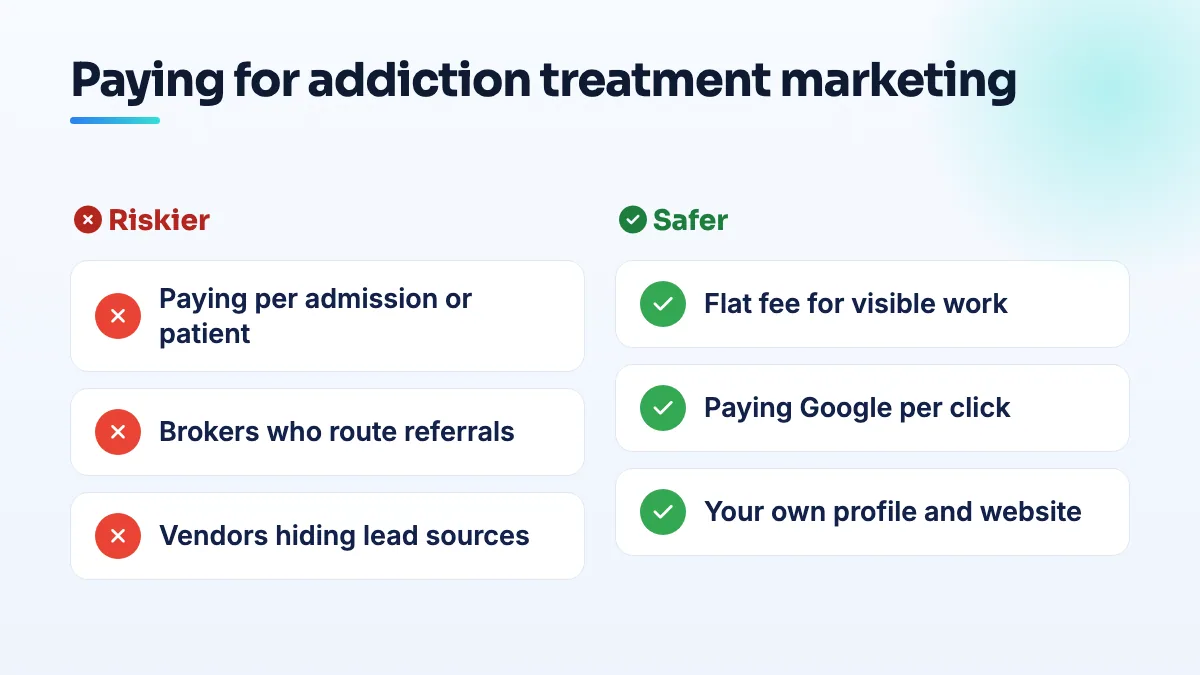
- Check how each one is paid. Per lead, per call, per admission, per patient, or a percentage of revenue is where risk concentrates. Write down the exact terms from the contract.
- Ask where the leads come from. If a vendor won't tell you which websites, ads or call centers produce the calls, I'd walk away. Some of those calls come from ads that impersonate real clinics, which the FTC has already sued over.
- Take the list to a healthcare lawyer. Before you renew anything, not after a subpoena. Ask them specifically about EKRA and your state's patient brokering law.
- Move spend to channels you own. Your Google Business Profile, your website, and, if certified, your own Google search ads. You pay for the work or the clicks, not for a person being steered to you.
Edge cases owners ask about
- Paying an SEO or ads agency. A flat monthly fee for work you can see is the structure I use and the one I'd recommend. Be wary of any agency offering to be paid per admission in this industry.
- Buying clicks from Google. Paying Google for clicks is paying for ad space, which is a different arrangement from paying someone to steer a patient to you. You still need LegitScript certification to run the ads.
- Call-tracking and answering services. Fine when you pay for the service, not for the patients it produces.
- Competitors impersonating you. That's a separate problem. If you think someone is bidding on your treatment center's business name and answering as you, document it before you do anything else.
Building patient flow you own takes longer than buying leads, and it's what our addiction treatment SEO work is set up to do. If you're weighing certification so you can advertise directly, the guide on LegitScript certification cost lays out the fees.
People also ask
Why do LegitScript-certified rehab ads get zero impressions?
Certification lets addiction ads run, but it doesn't make them win. Zero impressions usually means the certification isn't applied to the account and domain your ads use, a campaign targets a country where certified ads can't serve, your bids are far below the rehab market, or specific keywords aren't allowed to trigger. Check those four in that order, then take screenshots to Google Ads support.
Read the full answer: Why do LegitScript-certified rehab ads get zero impressions? →
Why did Google Ads restrict my therapy site for mentioning addiction?
Because your website offers addiction treatment, even as one service among many. Google's healthcare policy treats addiction services as restricted, and in the US and Canada that category needs LegitScript certification. The review reads your site, not only the ad, so one specialties line or blog post can restrict the account. You either remove the offer of addiction treatment from the site and appeal, or you get certified.
Read the full answer: Why did Google Ads restrict my therapy site for mentioning addiction? →
Can a sober living home have a Google Business Profile without showing its address?
Yes. Create one Google Business Profile for the operator, hide the address, and set a service area covering the towns where your homes are. Local search expert Phil Rozek advises against a profile per house, and I agree: every extra listing is another address you have to protect. Keep house numbers and street views out of your photos and website, and share addresses only with accepted residents.
Is AS9100 certification worth it, and does it help a machine shop get found?
Only if buyers you want already ask for it. Owners report around $10,000 and eight months for AS9100, and it won't rank a shop by itself. It helps when aerospace, medical or defense buyers filter on it, and only if you publish it clearly: a certification page with scope and expiry, and a mention on every relevant capability page.
Read the full answer: Is AS9100 certification worth it, and does it help a machine shop get found? →
Why were my childcare Google Ads restricted?
Usually because something in your account started to read as health-related or sensitive to Google's review systems, not because you broke a rule. Childcare ads and pages often mention medication, allergies, therapies or special needs, and audience lists built around parents can run into Google's limits on personalized advertising. Restricted means the ads still run, but to fewer people. Find the exact policy named, remove the trigger, appeal if it's wrong, and stop leaning on ads alone for enrollment.
Read the full answer: Why were my childcare Google Ads restricted? →