


Key points
- Best as a private portal for repeat clients
- A public storefront competes with online printers
- Uploaded files bring disputes walk-ins never had
- Custom work still needs a quote and a person
- Start with product pages and a file-upload form
Web-to-print sounds like the obvious answer when orders slow down: let customers upload a file, pay and walk away. My view is that a web-to-print storefront is worth it for a narrow set of printers, mainly those with business clients who reorder the same things, and a poor first investment for everyone else.
Why printers keep arguing about it
The question never settles. In an r/CommercialPrinting thread on whether to build a web-to-print storefront, owners go back and forth, and an older r/CommercialPrinting thread on the same storefront decision shows it's been unresolved for years. When a question keeps coming back, it's usually because the answer depends on the shop, not on the software.
What decides it is what you sell and who buys it. A storefront works when the product has a fixed spec and a fixed price. Most commercial print doesn't. In an r/CommercialPrinting discussion about quoting and estimating, printers describe pricing so complex that many build their own estimators rather than publish prices. If you can't put a price on a page, a storefront can't either.
The cost nobody mentions: file disputes
When a customer walks in, you look at the file together. You point out the missing bleed, the blurry logo, the font that didn't come through, and they agree to the fix before anything is printed. Online, that conversation disappears.
Printers in an r/CommercialPrinting thread about file problems with online orders describe exactly this: online ordering creates file-prep disputes walk-in orders never had. You either print the file as uploaded and get blamed for the result, or you hold the job and email the customer, who then wonders why they paid a website if they still have to talk to someone. Either way you've taken on the online printers' problem without their scale.
When a web-to-print storefront is worth it
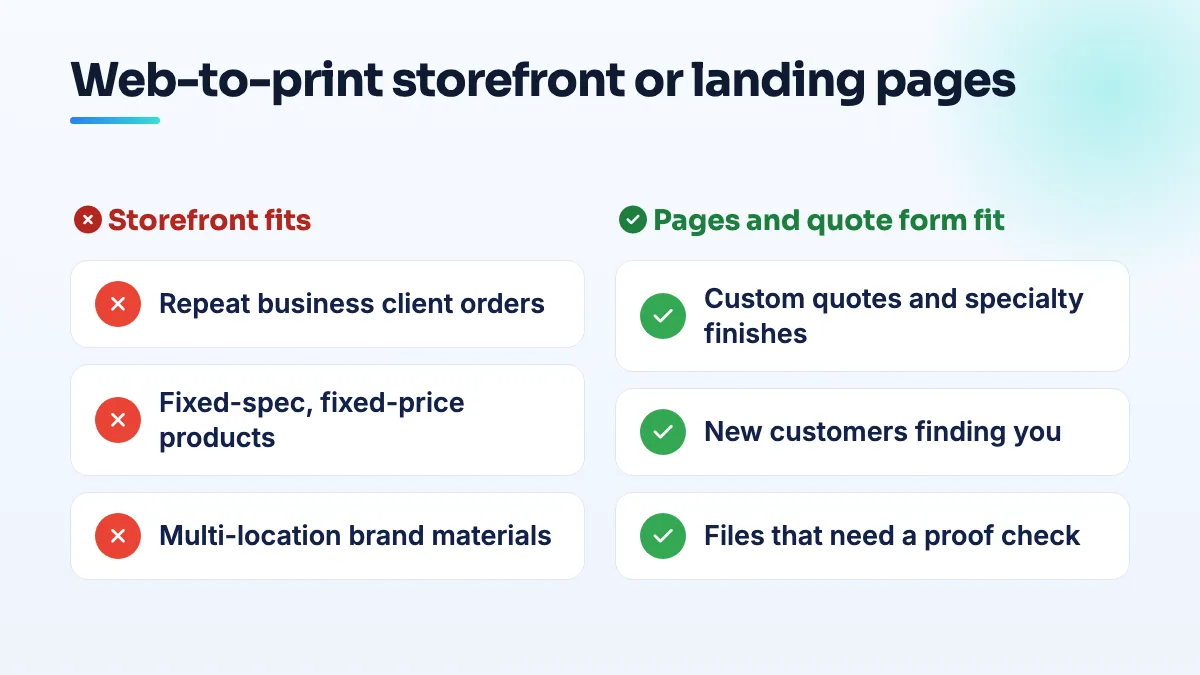
- Business clients who reorder the same items. Staff business cards, letterhead, envelopes, carbonless forms, branded stationery. A private, logged-in storefront with their approved templates and agreed prices saves you both time.
- Multi-location clients. Franchisees, clinics or branches that need the same materials in the same brand, ordered by different people.
- Products you already sell at a fixed spec. If a product never needs a quote, it can live in a storefront.
It's not worth it as your main public website if most of your work is custom quotes, large format, specialty finishes or jobs that need a proof conversation. That's also the work where you beat the online printers, so don't hide it behind a cart.
What I'd build first instead
- Write a page for each product you want more of. Sizes, stocks, finishes, turnaround, what files you accept and a few photos of the real thing. These pages are what people find when they search, and a storefront's product grid rarely ranks as well.
- Add a quote form that takes files. Ask for the product, quantity, size, stock, deadline and an upload. Reply fast, with a proof note if the file has problems. That keeps the conversation that stops disputes.
- Publish a file-prep guide. Bleed, resolution, color mode, fonts and accepted formats on one page, linked from every product page and the form.
- Show sample prices for your standard items. A short "starting at" table gives price shoppers an anchor without a full cart. I cover how far to go with print shop pricing online separately.
- Add a simple reorder form for regular clients. "Same as last order, new quantity" covers a lot of what a storefront would do.
- Then offer a private storefront to your top business clients. Once you know which clients reorder the most, build a portal just for them. The platform bill is easy to justify when it's tied to named accounts.
Questions to ask a web-to-print vendor before you sign
- What's the monthly cost, and does it rise with order volume or users?
- Does it check files on upload for bleed, resolution and fonts, and can you hold a job for a proof?
- Are the product pages on your own domain, and can Google index them?
- Who owns the customer list and order history, and can you export it if you leave?
- Can it handle your pricing rules, or will you be simplifying prices to fit the software?
If the answers to the last three aren't clear, I'd keep the storefront private and the public site on your own platform. The public site is what brings new customers, and it's the part where website design for a printer matters most.
The edge cases
If you're mainly competing with online printers on standard products, a storefront puts you in their game on their terms. I'd read the post on the local print shop vs online printer question before spending on one. If you run a trade-only shop that prints for other printers and resellers, a gated storefront can make sense as the ordering system for that trade, because your buyers already know how to prep files. And if you're adding one mainly for search traffic, don't: the pages that rank for a printer are product and service pages with real detail, which is the core of SEO for print shops.
People also ask
Should a local service business publish its prices online?
Yes, for most local service businesses. Publish fixed prices for fixed-scope jobs, a starting price or range for jobs that vary, and a quick estimator or quote form for custom work. Searchers who type "how much" want a number before they call, and pages that show one win the click. Add a date and a line that the final price is confirmed after inspection.
Read the full answer: Should a local service business publish its prices online? →
Can a print shop publish trade-only pricing without undercutting resellers?
Yes, as long as the trade prices sit behind a login and your public prices never undercut them. Put retail pricing or a quote form on the public site, and give approved resellers, sign shops and designers a separate trade account with their own price list and blind shipping. Sign shop owners describe trade-only pricing as the main defense against competing with your own customers, so the rule is simple: never quote a reseller's client below what the reseller would charge.
Read the full answer: Can a print shop publish trade-only pricing without undercutting resellers? →
How do you ask a B2B buyer for a Google review?
Ask one named person who saw the job go well, such as the engineer whose first article passed or the manager who watched your sign go up, within a day or two of the job. Ask in person first, then send a short email with your direct review link. Tell them they don't need to mention part numbers or their company, and never offer anything in return.
Read the full answer: How do you ask a B2B buyer for a Google review? →
Can a law firm call itself best or specialist on its website?
Usually not in the way marketers want. Under ABA Model Rule 7.1, "best" is an unsubstantiated comparison that can mislead, and Rule 7.2(c) bars stating or implying you are a certified specialist unless an approved or ABA-accredited body certified you and you name it. You can describe the areas you practice in. Always check your own state's rules, which often differ.
Read the full answer: Can a law firm call itself best or specialist on its website? →
Is buying addiction treatment leads legal under EKRA?
It can be, but how you pay decides it. EKRA makes paying for referrals to addiction treatment a federal crime, it covers private insurance, and in 2025 the Ninth Circuit confirmed it reaches marketing intermediaries. Paying per admission or per patient is where the risk sits, with penalties up to $200,000 and 10 years per occurrence. Have a healthcare lawyer review any lead deal. This is not legal advice.
Read the full answer: Is buying addiction treatment leads legal under EKRA? →