


Key points
- Get free local listings working first
- Same feeds as free listings, plus a budget
- Stock must update at least daily
- Test your best products for six to eight weeks
- Count visits yourself at the till
Local inventory ads are worth it for a single store only after free local listings are already running cleanly and your stock data is accurate every day. They use exactly the same product and inventory feeds, so the paid version can't fix a setup that isn't working for free. If it is working, a small, time-boxed test on your best products will tell you more than any opinion, mine included.
What local inventory ads need that free listings don't
Google's help page on local listings and local inventory ads sets out the shared requirements: a brick-and-mortar store in a supported country, plus store, price and in-store inventory data. If your website can't carry that data, Google offers a hosted store page. Free local listings are available in about 50 countries and local inventory ads in more than 80, according to the same page.
So the difference isn't the data. It's that local inventory ads add a Google Ads account, a budget and someone watching the campaign. For a single store, that someone is usually you, and the question is whether the extra shoppers are worth the money and the hours.
It's a question small sellers ask a lot. A Reddit discussion among resellers about Merchant Center listings is full of people unsure whether even the free listings are worth setting up, and in a Reddit thread where PPC managers discuss Shopping, the free organic side gets described as the most underused part of it. I agree with that: most single shops I see are skipping the free step and asking about the paid one.
When local inventory ads are worth it for one store
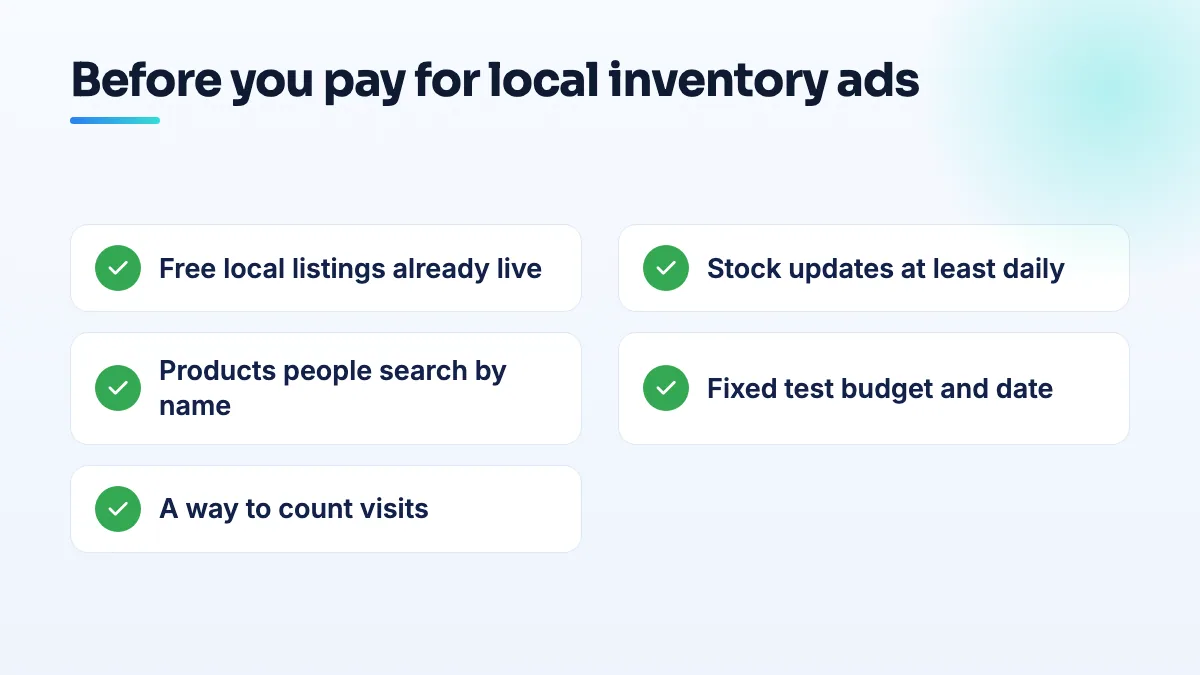
I'd only test them if every one of these is true:
- Free local listings are live and approved, and products are showing on your profile.
- Your stock data updates at least daily from your point-of-sale system, not by hand when you remember.
- You sell things people search for by name and are willing to drive for: a specific brand, model, size or part.
- The margin on those items covers a paid click that may or may not turn into a visit.
- You have a way to count visits, even a simple one like asking at the till or a code only shown in the ad.
How to test them without wasting money
- Run free local listings for a month first. If you haven't set them up, start with Google free local listings. Watch which products get views and clicks. That's your shortlist for the ads.
- Fix every disapproved product and price mismatch. Paying to promote a product Google has flagged just means paying for less.
- Set a fixed test budget and a fixed end date. Pick an amount you'd be comfortable losing entirely, and six to eight weeks, so there's time for enough clicks to judge.
- Limit the ads to your best products and a realistic radius. The customers who matter are the ones who'd actually drive to you, not the whole region.
- Count what happens in the store. In my experience, a single shop rarely has enough traffic for Google's own store-visit reporting to fill in, so use your own count at the till.
- Decide at the end date, not before. If sales from the test don't cover the spend, stop and put the effort back into free listings and your profile.
What's different for boutiques and general retail
For a clothing boutique, the hard part is the data. Every size and color is its own item, pieces sell out, and one-offs never come back. An ad for a size that sold yesterday costs you twice: the click and the disappointed customer. If your till system doesn't sync stock reliably, I'd hold off on ads. Owners also tend to assume an online shop will fix slow footfall; a small-business thread about wedding store sales has owners saying their online sales fell harder than in-store, which is one more reason to spend on getting local shoppers through the door rather than on a web store.
General retail shops with branded, searchable stock, like tools, bikes, parts or appliances, are the better fit. Someone searching a specific model near them is close to buying, and that's the search local inventory ads are built for.
If you do go ahead, Google Ads management is where we set up and watch the test, and for the free side we build it into boutique SEO and retail store SEO projects.
People also ask
Should you use Google Business Profile products or Merchant Center?
One shop with a small range that rarely changes can add products straight to its Google Business Profile, for free and without any feed. Use Merchant Center once you have a second store, a large catalog or an online store already, or when you want shoppers to see what's in stock today. Multi-location shops are effectively pushed to Merchant Center.
Read the full answer: Should you use Google Business Profile products or Merchant Center? →
Can you remove reviews left under a business's previous owner?
Usually not. Google treats reviews as a record of customers' experiences at the business, so reviews describing a previous owner's staff, prices or policies normally stay after a sale, and flagging them one by one as off topic rarely works. Report only the reviews that break a specific policy. Answer the rest publicly with a short, dated note that ownership changed, and outnumber them with new reviews from current customers.
Read the full answer: Can you remove reviews left under a business's previous owner? →
How do you claim a Google listing that has no claim button?
Start from Business Profile Manager instead of the listing. Add a business, pick your existing listing from the suggestions, and Google will either let you verify it or route you to its ownership request, which emails the current owner. If neither appears, check every Google account you've used, then post the Maps link in the Help Community so a Product Expert can look.
Read the full answer: How do you claim a Google listing that has no claim button? →
Why are my customers' Google reviews not showing up?
Usually because Google is holding the review back, not because it was never written. A filtered review stays visible to the person who wrote it, so their screenshot doesn't prove it's public. New or empty accounts, sudden bursts of reviews and anything rewarded are the usual triggers. If nobody at all can leave a review, check your profile for a suspension, a verification request or a ratings restriction.
Read the full answer: Why are my customers' Google reviews not showing up? →
When does a department or second entrance get its own Google Business Profile?
Only when customers deal with it as its own place. A department that has its own entrance or counter, its own phone line, its own hours and a category different from the main business can have its own listing, named as the business plus the department. A second door, a delivery gate or an internal team can't, and listing them causes duplicate flags.