

You woke up to five, eight or fifteen 1-star reviews from people you've never served, all within a few hours. Reported one at a time, each of those reviews looks like an unhappy customer and most will stay. A coordinated fake review attack gets taken seriously when you show Google the pattern: one log of every review, the accounts behind them, the timing and the wording, submitted as a single case.
I went through the Google Business Profile Help Community threads where plumbers, flooring companies, nail salons, boutiques, retailers, vets, landscapers and photographers were hit like this. The attacks look remarkably alike. So does the reason most reports failed: nobody connected the reviews to each other.
What a coordinated fake review attack looks like
These are the patterns owners documented, and they're the signals you're going to record:
- Throwaway accounts with matching histories. A nail salon in a Help Community thread about fake 1-stars hitting salons across one city checked every attacking account. Each had exactly two reviews in total. The other one was posted the same day, for a business on another continent. One account had also 1-starred another salon in town.
- Scripted wording and no details. A flooring company in a thread about scripted fake flooring reviews got 1-stars that all leaned on the same words, "disappointing", "rude", "poor communication", and never mentioned a job, a floor or a date.
- Ratings with no text, in a cluster. Another flooring business received five no-text 1-stars, three on the same day, traceable to no customer, in a thread about five no-text 1-star ratings. Escalation got silence.
- A burst right after a trigger. A boutique took four 1-stars inside one hour after a dispute with one customer, and its rating fell from 4.9 to 4.7, in a thread about four 1-stars inside an hour. None of the four were in its customer or invoice records. The owner was careful to say the original customer had every right to review. It was the other three that weren't real.
- Volume in one day. A retailer got eight 1-stars in a single day, still pending two weeks later, in a thread about eight 1-star reviews in one day. A veterinary practice described about fifteen in a very short window.
- An attack right after an update. A new landscaping company updated its profile and immediately got three fake reviews, the same week, and posted about it in the Help Community.
Plumbers describe a slower version: a 1-star a day, which the owner linked to three local competitors. A photography studio described being review-bombed by name. Slow or fast, what you record is the same.
Why reporting reviews one by one fails
Each report is judged on its own. A single 1-star saying "rude, poor communication" from an account with one other review is weak on its own. Eight of them, posted within hours, from accounts that each reviewed one business abroad the same day, is a pattern nobody would mistake for customers. Only you can put them side by side, because Google's form shows one review at a time.
The same lesson came out of the fake listing threads. In a thread about reporting a network of fake mover listings, the advice that worked was to report the whole network in one documented submission with a spreadsheet, not listing by listing. Reviews work the same way.
How to document the attack, step by step
- Don't reply to any of them yet. An angry reply in the first hour is what customers remember. You'll reply later, once, calmly.
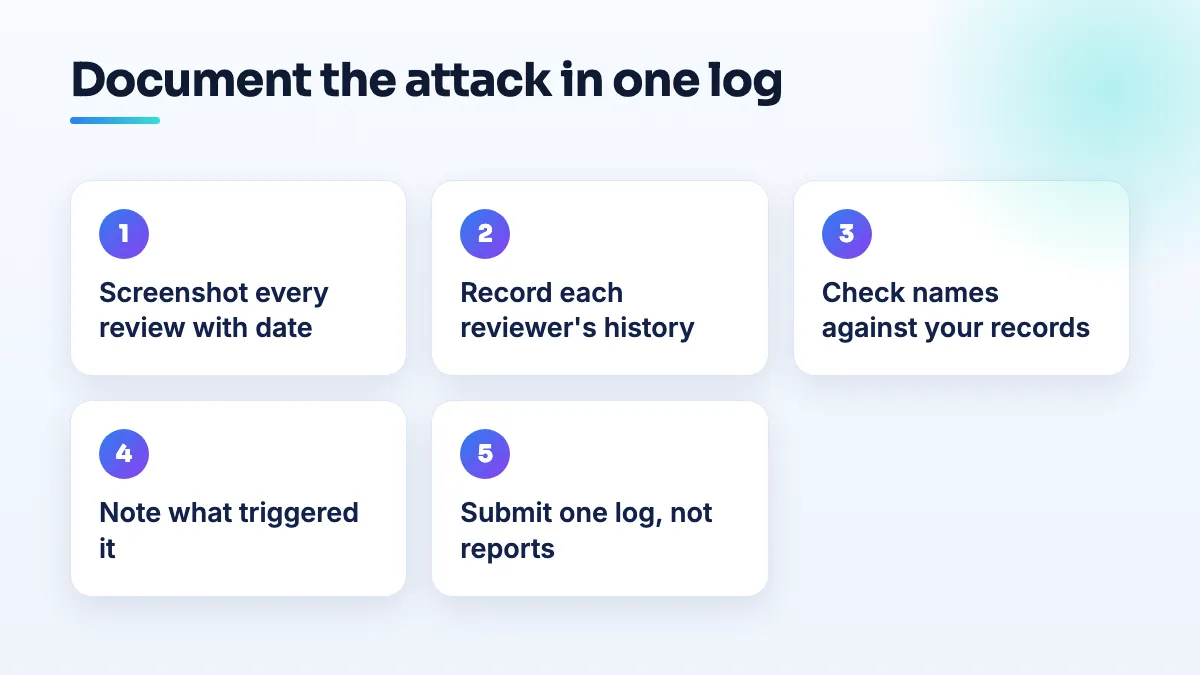
- Screenshot every review with its date. Capture each one from public Google Maps, showing the name, the stars, the text (or its absence) and how long ago it was posted. Note the exact date and your best estimate of the time.
- Open every reviewer's profile. For each account, record how many reviews it has, what else it reviewed, where those businesses are and when. Screenshot the profile. This is usually where the pattern shows.
- Check each name against your records. Bookings, invoices, CRM, appointment book. Record a simple yes or no. A "no" on its own won't get a review removed, but a column of them next to the rest is part of the pattern.
- Write down the trigger. A dispute, a refused job, a new competitor, a profile update, a local news story. Note the date. Google's reviewers need to understand why these arrived together.
- Build one log. Put it all in a single spreadsheet with the columns below, then write a three-sentence summary on top: how many reviews, over what time, and the pattern that links them.
- Report each review under fake engagement, then submit the log. Flag each review with the same category so the reports agree. Then contact Business Profile support and attach the log and screenshots, asking for the reviews to be looked at together as one coordinated attack.
- Post the evidence in the Help Community. Summarize the pattern, link the log if you can share it without personal information, and give the support case number. Product Experts can escalate a well-documented case, and a clear one is far easier to escalate.
The log Google can act on
| Column | What to record | Why it matters |
|---|---|---|
| Date and time | When each review appeared | Shows the burst |
| Stars and text | The rating and the exact words, or "no text" | Shows scripted or empty reviews |
| Reviewer account | Total reviews, other businesses reviewed, their locations and dates | Shows throwaway or linked accounts |
| In your records? | Yes or no | Supports the pattern, never enough alone |
| Trigger | What happened just before | Explains why they arrived together |
| Report status | Date reported, category, current status | Keeps your one appeal for later |
What changes by industry
- Nail salons and boutiques tend to get hit after a dispute at the counter, by the customer's friends. The dispute customer may have a right to review. The friends usually don't. Separate them in your log, as the boutique owner did, and it's far more credible. It's how I handle it in nail salon SEO.
- Flooring companies and plumbers see attacks linked to competitors, with scripted wording that never names a job. For trades, the job detail is your best evidence: a real customer mentions the kitchen, the leak, the date. I lean on that in flooring company SEO and plumbing SEO cases.
- Vets and pet businesses get bursts after a public dispute or a social media post. Save the post that started it, with its date, as part of the trigger.
- Retailers get the biggest volumes in one day. Screenshot fast, because a throwaway account can be deleted, taking its review and your evidence with it.
- Landscapers and photographers are often small, newer businesses where five fake reviews can outnumber the real ones. Keep asking every genuine customer for a review during the attack.
What not to do
- Don't post fake 5-stars to balance it out. It gives Google a reason to treat your whole profile as manipulated.
- Don't accuse a competitor by name in a reply. Put the evidence in the report, not the public reply.
- Don't spend your appeals as soon as the first reports come back. Wait until your log is complete, then appeal each review once with it.
- Don't pay anyone to make it stop. Some attacks are followed by an offer to remove the reviews for money. That's extortion, and I cover it in the guide on review extortion on Google.
- Don't skip the backup. A mover lost more than 1,000 genuine reviews right after reporting fake ones. Before any big report, follow my steps to protect Google reviews you already have.
After the attack
Reply to each fake review once, in the same calm words: "We have no record of this visit and have reported this review to Google." For single reviews that come later, my guide on how to report a fake Google review covers the clause and wording. For the longer view of how reviews, replies and ratings fit together, read about online reputation management.
If you're in the middle of an attack and want the log built and the case escalated, that's something we do as part of our Google Business Profile management.
Written by Saifur Rifat, Founder & SEO Lead at SERP Squad.