

Your directory contract is coming up for renewal, the inquiries have been thin or strange, and you can't tell whether the listing is paying for itself. Is WeddingWire worth it? Only if the bookings you can trace to it cover a full year's cost with a clear profit, and only if you're not relying on it as your whole marketing plan. The Knot and WeddingWire are the same company, so paying for both doesn't spread your risk.
This is aimed at wedding photographers and planners, because that's where the complaints I read were concentrated, but the same test works for florists, venues and DJs. Below is who owns what, what vendors report about the contracts, how to measure your own return, and what to build alongside it.
The Knot and WeddingWire are one company
A lot of vendors list on both to "diversify". According to Wikipedia's entry on The Knot Worldwide, the merger was announced in September 2018 and completed in March 2019, and the combined parent was renamed The Knot Worldwide, controlled by Permira Funds and Spectrum Equity. Its brands include The Knot, WeddingWire, WeddingPro, The Bash, The Bump and international sites such as Bodas.net and Hitched.
So two listings mean two invoices to one owner. If that company changes its lead rules, its prices or its review policy, both listings change together. That isn't diversification. It's the same bet placed twice.
What vendors report about the contracts and leads
WeddingWire's Trustpilot page scores it 1.4 out of 5 across 2,855 reviews. Trustpilot draws unhappy customers more than happy ones, so I read it for patterns, not for the average. The patterns are consistent and recent:
- Twelve-month lock-in. Several vendors describe being unable to leave once the contract is signed. One wrote that they were locked into a 12-month contract with "NO guaranteed clicks, NO minimum guaranteed leads".
- Money spent with nothing booked. One vendor in December 2025 reported spending more than $1,600 for zero bookings.
- Junk leads. A vendor in August 2026 described receiving false leads and scams through the platform.
- Sales promises that didn't hold. One vendor wrote in July 2026 that sales staff had misled them more than once.
- Reviews and accounts removed. Vendors report negative reviews about the directory disappearing and accounts closed without notice.
None of that means the listing can't work for you. It means the contract carries the risk, not the platform, and you need your own numbers before you renew.
Why the listings still matter
When I searched "wedding photographer Asheville NC", The Knot was first and WeddingWire second, with a Facebook page third and individual photographers only after that. Couples start there. Dropping the listing without anything to replace it means disappearing from the first page couples see, which is why I'd never tell a vendor to cancel on principle. The question isn't whether the directory ranks. It's whether the listing books weddings.
How to decide whether WeddingWire is worth it for you
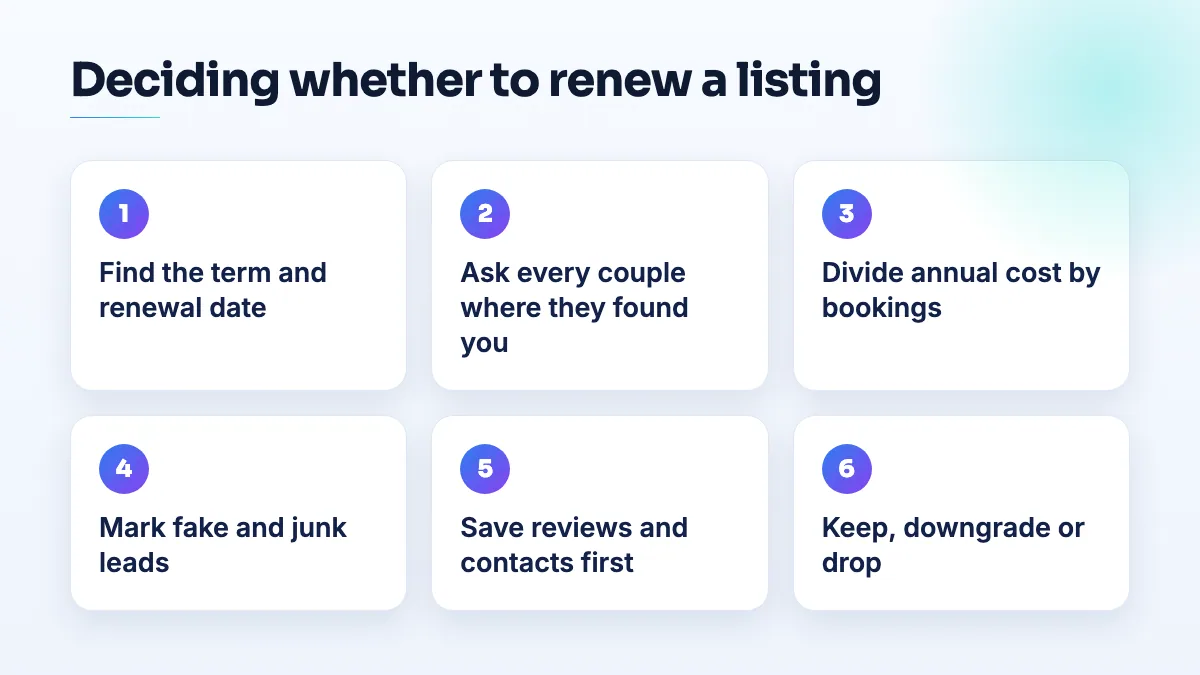
- Find your contract term, renewal date and notice period. Read the signed agreement, not the sales email. Put a reminder in your calendar 60 days before renewal so the decision is yours, not automatic.
- Ask every couple where they first found you. On the inquiry form and again at the consultation. Couples often see you on a directory and then search your name, so your website analytics alone will undercount the directory and your own site will look better than it is.
- Divide a year's cost by the bookings it produced. Add up everything you paid the platform in 12 months, including upgrades, and divide by the weddings you booked from it. That's your cost per booking. Compare it to what a wedding is worth to you after your time and costs, not to your package price.
- Mark junk leads as they come in. Scams, couples far outside your area, dates you told the platform you're booked. If a big share of your inquiries are junk, your real cost per lead is much higher than the dashboard says.
- Save your reviews and contacts before you decide. Screenshot every review with the couple's name and date, and keep every inquiry in your own spreadsheet or client system. Given what vendors report about removed accounts, don't let the platform be the only place those exist.
- Keep, downgrade or drop at renewal. If the listing paid for itself clearly, keep it. If it's marginal, ask for a lower tier or a shorter term in writing. If it didn't cover its cost, drop it and move that budget into what you own.
How it compares with pay-per-lead platforms
Some vendors leave annual contracts for pay-per-lead sites and find a different problem. Thumbtack's Trustpilot page scores it 2.2 out of 5 across 6,618 reviews, with pros reporting more than $130 for a single lead, one lead sold to four professionals at $80 or more each, and charges for leads outside their stated service area. You're not locked in, but every lead is shared and the cost lands whether you book or not. I go through the arithmetic in the guide to the real Thumbtack lead cost and its competitors.
What to build that you own
Whatever you decide about the directory, these are the pieces no platform can switch off:
- A Google Business Profile set up correctly. Most photographers and planners work from home and meet couples at venues. That means a service-area profile with the home address hidden and a realistic service area. In a Help Community thread from a home-based wedding photographer suspended with 50 reviews, that was exactly the fix a Product Expert pointed to.
- Google reviews, not only directory reviews. Ask every couple for a Google review first. Those stay with your business whatever happens to a contract.
- Venue pages on your own website. One page per venue you've shot or planned at, with real photos from that day and what couples should know about the venue. Couples search venue names, and a directory's category page can't match a gallery from the actual room.
- A clear pricing or starting-price page. It filters out couples who were never a fit, which is half of what you're paying a directory to do badly.
Directories will keep the broad "wedding photographer" and "wedding planner" results. The searches you can win are narrower, and I set out how to find them in how to compete with directories in search.
What's different for photographers and planners
Photographers have the easier path to owned traffic, because every wedding produces a gallery that can become a venue page. The directory is often most useful for couples who haven't picked a venue yet. For photographers who want to rank on their own name and venues, that's the focus of our wedding photographer SEO.
Planners have fewer visual assets and more trust to earn, since couples hand over the whole day. Planner pages that explain how you work, what full and partial planning include, and which venues you know well do more than a directory badge. Planner-specific setups are in our wedding planner SEO work.
What not to do
- Don't sign up for both directories to diversify. It's one company.
- Don't let the contract renew without a decision. The reminder 60 days out is the most valuable thing in this post.
- Don't accept a verbal promise about leads. If a number matters to you, it needs to be in the contract.
- Don't send every happy couple to review you on the directory only. Split your requests, with Google first.
- Don't cancel without a replacement. Build the profile and venue pages first, then decide at renewal with numbers in hand.
Where to start
Pull your contract and your last 12 months of bookings this week and work out your cost per booking. If you want help building the profile and pages that reduce how much you depend on a directory, that's what our local SEO services are for.
Written by Saifur Rifat, Founder & SEO Lead at SERP Squad.