

A 1-star appears about a job you never did, and within hours a message arrives on WhatsApp offering to delete it if you pay. That is review extortion on Google, and the answer is the same every time: don't pay, don't negotiate, keep every message, and report the review and the demand to Google together.
I went through the Google Business Profile Help Community threads where towing companies, phone and computer repair shops, appliance repair businesses, roofers and HVAC companies described these demands. The scripts vary a little. The mistakes that make them worse don't.
Below is how the schemes work, the evidence to keep, the order I'd report things in, and what to do when the review hasn't even shown up in your dashboard yet.
How review extortion on Google works
There are three versions in the threads I read, and it helps to know which one you're dealing with.
- The stranger with a demand. A towing company in a Help Community thread about a 1-star followed by a WhatsApp money demand got a review describing services it doesn't even provide. Then a foreign WhatsApp number demanded money to delete it. An appliance repair business described the same sequence in a thread about 1-stars posted and money demanded to remove them.
- The "review service" that punishes a no. A roofing company was offered paid review services, refused, and was then hit with a coordinated set of fake 1-stars, as described in a thread about fake 1-stars after refusing a paid review service.
- The customer who trades a rating for money. Repair shops report customers demanding a 50% refund over WhatsApp in return for changing a 1-star into a 5-star. This one involves a real customer, which changes how you handle it (more on that below).
An HVAC company took its case further and treated it as a legal matter, in a thread about HVAC review extortion escalated legally. That's an option when the threats are serious, and I'd take it with a lawyer rather than alone.
Why you should never pay
- Nothing guarantees the review goes. You'd be paying someone who has already shown they'll lie about your business.
- Paying marks you. A business that pays once is the business that gets the next demand.
- It breaks Google's rules on your side too. Money or a refund in exchange for removing or changing a review is the kind of incentive Google's review policy forbids. If that trade ever surfaced, it's your profile that carries the risk.
- It destroys your evidence. Once you've paid, your report to Google no longer reads as a clean extortion case.
What to do, step by step
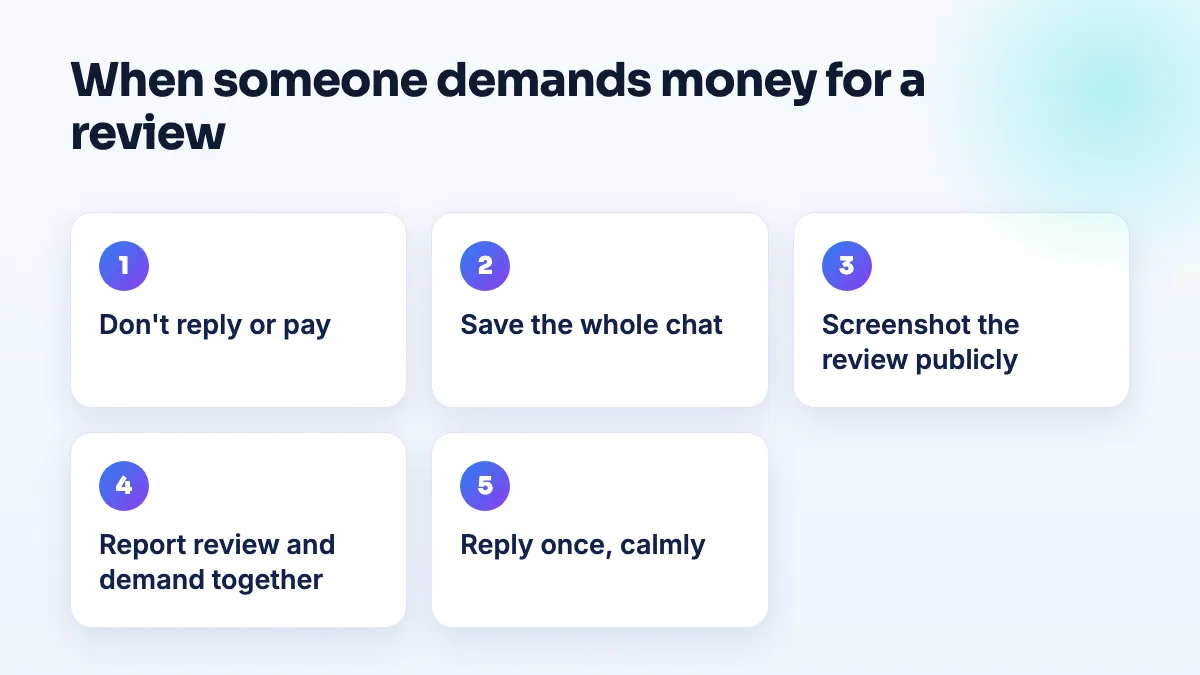
- Don't reply to the message. Not to argue, not to ask how much, not to threaten. Anything you write can be screenshotted and used, and a reply tells them the number reaches a decision-maker.
- Save the whole conversation. Screenshot every message with the sender's number and the timestamps visible, and export the chat from WhatsApp if you can. Save any payment details they send. Store copies somewhere other than the phone.
- Screenshot the review from public Google Maps. Capture the reviewer's name, the stars, the text and the date. Then open the reviewer's profile and screenshot their other reviews. Note whether the same account left 1-stars on other businesses that day.
- If the review isn't in your dashboard yet, wait for it. The towing company couldn't flag its review at first because it was too new to show up on the owner's side. Keep the public screenshot, check again daily, and report it as soon as it appears.
- Report the review and say it's extortion. Flag it as fake, since the review describes work that never happened. Look in the Business Profile Help Center for a form specifically for review extortion and use it if it's offered for your account, because it lets you attach the messages. If you can't find one, contact Business Profile support, state plainly that the review was followed by a demand for money, and attach the screenshots.
- Post the facts in the Help Community. Include the date of the review, the date of the demand and your case number, with personal details and phone numbers blurred. Product Experts can escalate a clear case.
- Report and block the number. Report the account inside WhatsApp, then block it. If the messages include threats to you or your staff, report them to your local police as well.
- Reply to the review once. Keep it short and factual: "We have no record of this job and don't offer this service. We received a demand for payment to remove this review and have reported both to Google." Customers reading it will understand.
When a real customer demands a refund for a better rating
This one is different. The review may describe a real job, and the customer may even have a point. Deal with the complaint and the review separately.
- If the work was genuinely wrong, fix it or refund it on its merits, in writing, with no mention of the review.
- Never make a refund conditional on the review being changed. Say so in writing: "We're refunding this because of the issue with the repair. It isn't linked to your review."
- If the customer puts the trade in writing, keep it. A review offered in exchange for money is a policy problem for them, and the message is your evidence if you report it.
What changes by industry
- Towing companies are the easiest target, because most people they deal with are unhappy by definition and a fake angry review blends in. The detail that helps is the one in the towing case: the review describes a service you don't offer. Put that first in the report. It's something I check early in tow company SEO work.
- Phone and computer repair shops see the refund-for-rating version most, from walk-in customers. Keep job tickets detailed, because the ticket is how you show the work was done as agreed. I cover the rest in phone repair SEO.
- Roofers get the "review service" pitch, often dressed up as reputation management. Keep the sales email or call log. If 1-stars follow a refusal, that timing is the evidence, and I'd treat it the same way in roofing SEO cases.
- Appliance repair and HVAC companies tend to see the demand arrive after several 1-stars at once. Log them together as one attack before reporting.
If the extortion came with several reviews at once, document them together. My guide to a coordinated fake review attack shows the log I use. For a single fake review with no demand attached, see how to report a fake Google review by citing the right policy.
What not to do
- Don't pay, even a small amount. There's no small amount that ends it.
- Don't hire anyone who contacts you offering to remove the review. Offers that arrive right after an attack are sometimes from the people behind it.
- Don't delete the chat to get it off your phone. Archive it. You'll want it for Google, WhatsApp and possibly the police.
- Don't post the extortionist's number in your public reply. Put it in the report, not on your profile.
Getting help with it
Extortion cases are stressful because they arrive with a deadline. The deadline is theirs, not Google's. If you'd like the evidence packaged and the case escalated for you, that's part of our Google Business Profile management.
Written by Saifur Rifat, Founder & SEO Lead at SERP Squad.