

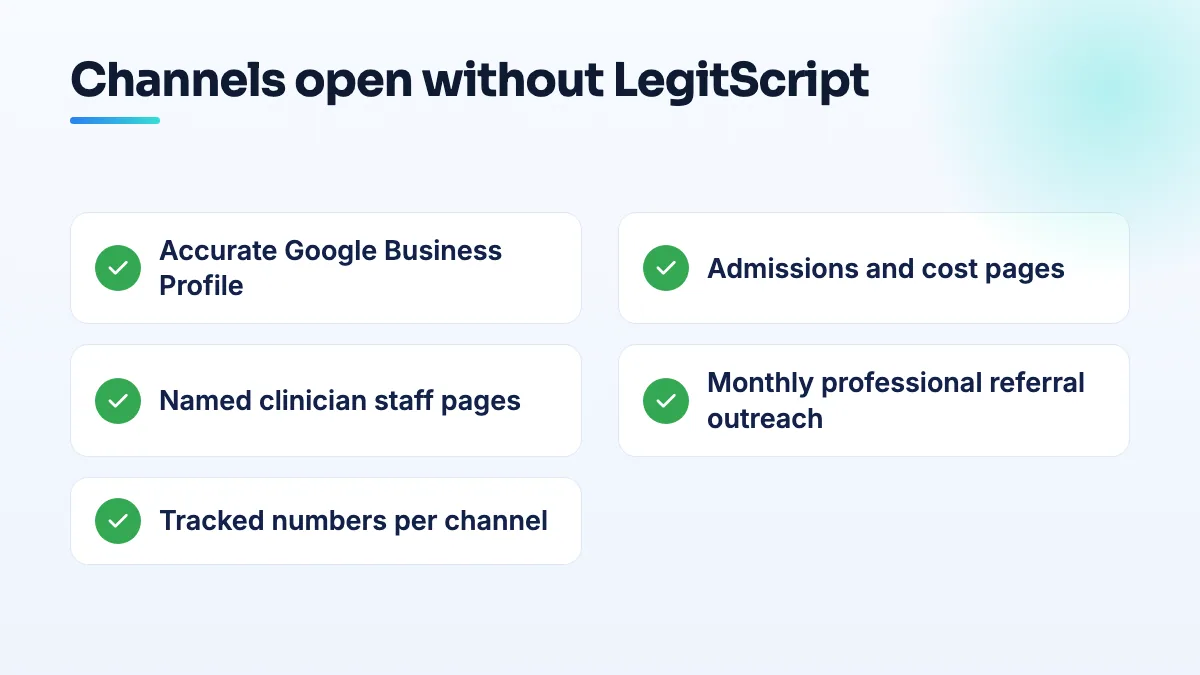
If your program can't get LegitScript certified, Google Ads and Meta ads for addiction treatment are closed to you, and no amount of rewording will open them. Marketing without LegitScript certification means building on the channels that don't need it: your Google Business Profile, a website that answers what families search, and referrals from professionals who already see the people you help.
This hits programs that are real and useful but don't fit the certification: peer-led and non-medical programs with no doctors on staff, programs that don't offer medication-based treatment, and counselors who treat gambling or gaming addiction. I went through what owners in these positions posted when they found out, and the plan below is what I'd build for them.
Why your program can't get certified
Two separate rules close the door, and it helps to know which one applies to you.
The first is LegitScript's own eligibility. A center owner described in a Reddit thread from a center ruled ineligible for LegitScript finding out the program didn't qualify because it had no doctors and no medication-based treatment. LegitScript's addiction treatment certification standards are written for licensed clinical treatment, and a program built another way can fail them without doing anything wrong.
The second is Google's scope. Google's healthcare and medicines policy says impulse-control, behavioral and nicotine addiction are out of scope for its addiction services certification. In practice that leaves providers in a gap. A counselor argued in a Reddit thread on gambling and gaming addiction ads that because those services can't be certified at all, they can't be advertised either.
Outside the US and Canada the gate is tighter still: in Australia, France, Ireland and New Zealand, only government entities can advertise addiction services on Google. And Meta asks for LegitScript certification plus its own written permission, so paid social isn't a way around it.
What marketing without LegitScript certification still allows
The certification is an advertising rule. It governs ads, not whether you can be found. Everything below is open to you.
| Channel | Open without certification? | What to watch |
|---|---|---|
| Google Ads for addiction treatment | No (US and Canada) | Ads for your other services can still be restricted if the site offers addiction treatment |
| Meta ads for addiction treatment | No | Needs LegitScript and Meta's written permission |
| Google Business Profile and Maps | Yes | The rehab map pack has a spam problem, so your details must be spotless |
| Your website in organic search | Yes | Health content is judged harder on who wrote it and why it's trustworthy |
| Professional referrals | Yes | Never pay per referral or per admission |
| Bought leads | Avoid | Federal kickback law reaches marketing middlemen |
The patient acquisition plan, step by step
This is the order I'd do it in. The first three steps cost time rather than money, and they're the ones that decide whether the rest works.
- Confirm exactly why you're ineligible, in writing. Keep LegitScript's decision or the eligibility standard you fail. If the only gap is something you plan to add, like a medical director, you may be certifiable next year, and that changes how much you invest in the steps below. If you treat gambling or gaming addiction, there's no path, so plan as if ads don't exist.
- Keep addiction treatment off any site you do advertise. If you run ads for another service, such as general counseling, those ads can be restricted because the same site offers addiction treatment. Owners report exactly that. Either stop the ads or run them to a separate site that doesn't offer addiction services. I explain how that restriction is triggered in why psychotherapy ads get restricted.
- Set up your Google Business Profile as the front door. Use your registered name with nothing added, a primary category that matches what you actually provide, your real address if people come to you, accurate hours and a phone number someone answers. Owners on the Local Search Forum describe the rehab local pack as filled with spam in a thread on rehab categories, so a clean, verified, accurate profile already stands out. Don't add "rehab" or a city to your name to compete. It's a suspension risk.
- Write the pages families actually search for. Admissions: who you take, how to start, what happens on the first call. Cost and payment: what you charge, what insurance you work with and what you don't. A day in the program. Family involvement. Aftercare. Each page should answer one question fully, in plain words, with a named clinician or program lead who reviewed it.
- Put your people on the website. A page for each clinician or counselor with their license or certification, training and role. Google's guidance on helpful content asks who created a page and why they should be trusted, and that question is weighted harder on health topics. It doesn't require a particular credential. It rewards being clear about who stands behind the content.
- Build a referral list and work it every month. List the people who meet your future clients before you do: therapists without addiction training, primary care practices, employee assistance programs, hospital social workers, court and probation contacts, school counselors for gaming addiction. Send each one a one-page summary of who you take and how to refer, then follow up in person.
- Track every call by source. Use a different tracked number on the website, the Google profile and your referral materials. After three months you'll know which channel fills beds or appointments, and you'll stop guessing where to spend.
What's different for your kind of program
Non-medical and peer-led programs
You're competing in search with licensed facilities that can also advertise. Don't pretend to be one. Say clearly what your program is and isn't, who it suits, and when you'd refer someone to a medical setting. It's also the honest position, and it keeps your pages accurate if a regulator or a referral partner reads them.
Gambling and gaming addiction counselors
Your searchers often don't use the word "addiction". Parents search for help with a teenager who won't stop gaming; partners search about debt and hidden betting. Write pages in those words. Your referral list looks different too: financial counselors, school counselors and family therapists see these clients first.
Therapy practices that treat addiction alongside other work
If you're a general practice, the cleanest setup is often to keep addiction work off the site you advertise and let it come through referrals and your Google profile. That lets you keep running ads for everything else. It's a trade-off I talk through at the start of any addiction treatment SEO project.
What not to do
- Don't buy leads or pay per admission. The federal kickback law for recovery (EKRA) reaches marketing intermediaries, and LegitScript's standards include no affiliation with lead generators, so it would also close the door if you ever become eligible. Talk to a healthcare lawyer before any paid referral arrangement.
- Don't run ads under a vague name hoping review misses you. An ad that hides what you offer is a misrepresentation problem, which is worse than a restriction.
- Don't create extra Google profiles for each program or house. One accurate profile per real location.
- Don't fill the site with thin pages for every city nearby. A handful of strong pages written for families will do more than dozens of near-identical ones.
Questions program owners ask
Will I ever be able to run Google Ads?
If you add what the certification requires and pass it, yes, in the US and Canada. If you treat behavioral addictions only, not under the current policy. Check the policy page every year, because Google does change it.
Can I advertise my general mental health services instead?
Yes, as long as the site those ads point to doesn't offer addiction treatment. That's the part owners miss.
How long does the organic route take?
Longer than ads, and I won't pretend otherwise. Website pages take months to earn steady rankings. That's why I'd fix the Google profile first and start the referral work on day one, since neither depends on waiting for rankings.
Where to start this week
Confirm your eligibility status, fix the Google profile, and write the admissions and cost pages. If you want help writing pages that clinicians sign off and families trust, that's our SEO content writing. And if you're weighing whether to add what certification needs, the guide on LegitScript fees for addiction treatment sets out what it would cost.
Written by Saifur Rifat, Founder & SEO Lead at SERP Squad.