

A customer approves a sign, the permit stalls or gets refused, and suddenly you're the one being blamed. Who pulls the sign permit is one of the most argued questions among sign shops, and the answer that ends the argument is the same everywhere: decide it in writing before you quote, and explain it on one page your customers read before they buy.
The stakes are real on both sides. In a Signs101 thread on who is responsible for pulling a sign permit, shops say they charge anywhere from $35 to $500 to handle the permit, and many refuse to build anything until it's approved. In a Signs101 thread about installing signs without a permit, owners describe what happens when someone skips it: fines, strikes against a contractor's license, and signs ordered taken down.
Here's how I'd settle who pulls it, what to charge, how to write it into the job, and how to turn the whole question into a page that brings in customers.
Who pulls the sign permit: the practical answer
Who is allowed to apply depends on your city or county. Some let the property owner or the business apply, some expect the installing contractor to apply, and many need drawings and installation details only the sign shop has. So the first job is to check the rules in each place you install, not to argue about them with a customer.
My view is that the sign shop should pull the permit in almost every case, and charge for it. You have the drawings, the dimensions, the mounting method and the electrical details. You're the one on the ladder when the inspector turns up. And if the sign goes up without approval, it's your license and your install crew the city deals with, whatever the customer promised.
What the customer supplies is everything about the property: the landlord's written approval, the building frontage measurements if you haven't surveyed it, and any center or association sign rules that apply on top of the city's code.
What a sign permit costs and who pays
There are two separate costs, and customers often confuse them. Putting both on the quote as separate lines prevents most arguments.
| Cost | Who sets it | What to tell the customer |
|---|---|---|
| The city's permit fee | The city or county | Passed through at cost, amount confirmed when you apply |
| Your permit handling fee | Your shop | Covers drawings, the application and follow-up; shops report charging $35 to $500 |
| Extra drawings or engineering, if required | The city's requirements | Quoted separately if the city asks for them |
| Electrical permit or inspection for lit signs | The city or county | Check locally; it can be a separate approval |
A flat handling fee is easier to sell than an hourly one. Customers accept a fixed line on a quote. They argue with an invoice for "permit time".
What happens when a sign goes up without a permit
The owners in the no-permit thread list the consequences plainly: fines, strikes on the installer's license and signs that have to come down. A Signs101 thread from a shop seeking a waiver after installing without a permit shows how hard it is to fix after the fact.
The customer who pushes you to "just put it up, we'll sort the permit later" won't be the one paying the fine or removing the sign. I'd never install before approval, and I'd put that sentence on the website so the conversation is over before it starts.
How to set a permit policy that ends the arguments
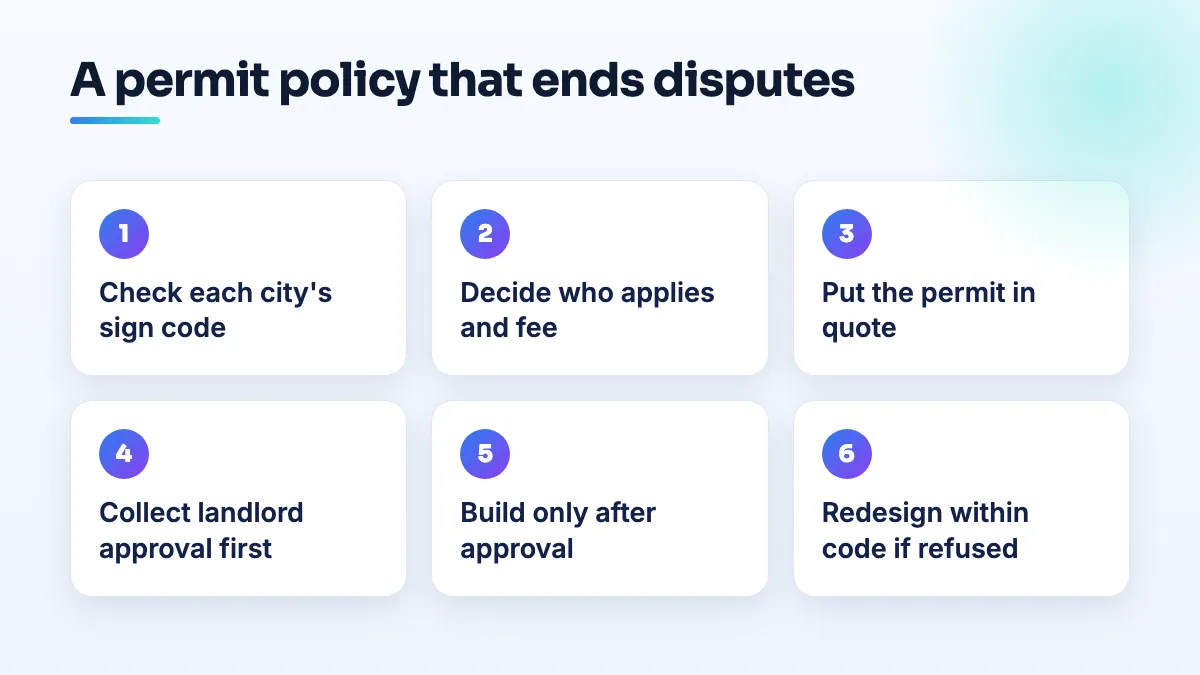
- Find the sign code and application process for each city you work in. Save the links, note who can apply, what drawings they want and whether lit signs need a separate electrical approval. Update it when a job teaches you something new.
- Decide who applies and what you charge. Pick a flat handling fee, or a small set of fees by sign type, and use it on every quote.
- Put the permit in the quote and the contract. A line for the city fee, a line for your fee, and one sentence: fabrication starts after the permit is approved. Add what happens to the deposit if the permit is refused.
- Collect the paperwork before you apply. The landlord's written approval, site photos, frontage measurements and any shopping center sign rules. I ask for the landlord approval first, because without it nothing else moves.
- Tell the customer the timeline honestly. Don't promise an approval date you don't control. Tell them what you've seen in that city before and that you'll update them when the city responds.
- If the permit is refused, offer a redesign within code. Smaller letters, a different mounting, no illumination. The customer still gets a sign, and you keep the job.
How to explain permits on your website
Business owners search this question before they ever call a sign shop: do I need a permit for a sign, who gets it, how long it takes. A page that answers it clearly puts you in front of customers early, and the ones who call after reading it already understand your process.
This is what I'd put on a sign shop's permit page:
- Who pulls the permit. "We handle the permit for every sign we install," or whatever your policy is, in the first line.
- What it costs. The city fee passed through at cost, your handling fee, and a note on lit signs.
- What we need from you. Landlord approval, site details, and any center sign rules.
- How long it takes. An honest range for the cities you work in most, with a note that the city sets the pace.
- What if it's refused. The redesign offer and what happens to the deposit.
- Why we don't install without one. Fines, removal and the risk to the business owner, in two sentences.
Then, for the cities you work in most, write a short page on each city's sign rules in plain English, with a link to the official code. Heights, setbacks, illumination and what needs a permit are the questions owners ask. Only publish what you've checked against the code itself, and date the page, because ordinances change. Some sign shop owners on Signs101 have even taken proposals to their city councils to change local sign ordinances, which tells you how much these rules vary from town to town.
Pages like these are some of the most useful service page writing a sign shop can do, because they answer a question no franchise template or online sign seller answers for your town.
Where permits meet the rest of your sales process
Permits matter most on the jobs that pay best. In my experience property managers and general contractors want a sign shop that handles permits without being asked, and it's often what decides commercial sign contracts. The same principle of answering the pricing question before the customer asks applies to wraps, where I cover flat rate vehicle wraps separately.
What not to do
- Don't install before approval, whatever the customer says about their opening date.
- Don't leave "who pulls it" unwritten. If the customer insists on applying themselves, put that in the contract, and make clear you won't install until you've seen the approval.
- Don't copy another city's rules onto your page. Link to the official code for each city and summarize only what you've checked.
- Don't promise approval dates. Promise updates.
- Don't hide the permit fee in the sign price. Separate lines make your quote easier to compare and harder to argue with.
The next step
Write your permit policy in three sentences this week and put it on every quote. Then turn it into the page. If you'd like help building the permit page and the city pages around it, it's part of the sign shop SEO work we do.
Written by Saifur Rifat, Founder & SEO Lead at SERP Squad.