

If your sign shop lives on walk-in banners and one-off window lettering, you're competing on price with every shop, franchise and online printer in town. Commercial sign contracts are where the margin is: apartment communities, shopping centers, hospitals, schools and chains rolling out the same sign across ten locations. The problem is that those buyers don't find you the way a walk-in does, so your website and your profile have to be built for them on purpose.
This is how I'd set a sign shop up to be found and shortlisted by property managers, general contractors and multi-site buyers: which pages to build, what proof they look for, and what to stop doing.
Why walk-in work won't carry a sign shop
Owners say it themselves. In a Reddit thread about whether a sign business is worth starting, the point that keeps coming up is that entry is cheap, the market is crowded, and the profit comes from big contracts with malls, apartment complexes, hospitals and schools rather than from banners. Over on Signs101, a thread about cheap customers grinding sign shops on price has owners describing regulars who called $6 per square foot for cut vinyl and install too much.
Add the franchises with national advertising behind them, big-box stores selling signage, and online sign sites shipping banners overnight, and the small-job end of the market is the worst place to fight. The commercial end is different. A property manager replacing signs across four buildings isn't choosing on the cheapest banner. They're choosing a shop they trust to survey, permit, install and come back when something breaks.
One owner on Signs101 put the local reality bluntly in a thread on the sales and marketing that works for sign shops: "If you don't hit the first page on Google your phone ain't gonna ring." That's true for commercial buyers too. They just search for different things.
What commercial sign buyers search for and check
A walk-in searches "sign shop near me". A commercial buyer searches for the job and the type of property, then checks you before they ever call. In my experience working on B2B sites, the search looks more like these:
- Property managers: "apartment community signage", "monument sign replacement", "tenant panel signs for shopping center", plus the city.
- General contractors: "sign contractor for new construction", "sign installation subcontractor", "ADA room signs" for a fit-out they're bidding.
- Facilities teams at hospitals and schools: "wayfinding signage", "interior directional signs", "campus signage".
- Multi-site brands and franchisees: "sign rollout" or "national sign installation", often looking for a shop that can survey and install in their region.
Once they find you, they check three things fast: have you done this kind of property before, can you handle the process (surveys, permits, scheduling, maintenance), and are you a real, insured company they can put on an approved vendor list. Your site has to answer all three without a phone call.
How to build a sign shop's presence for commercial sign contracts
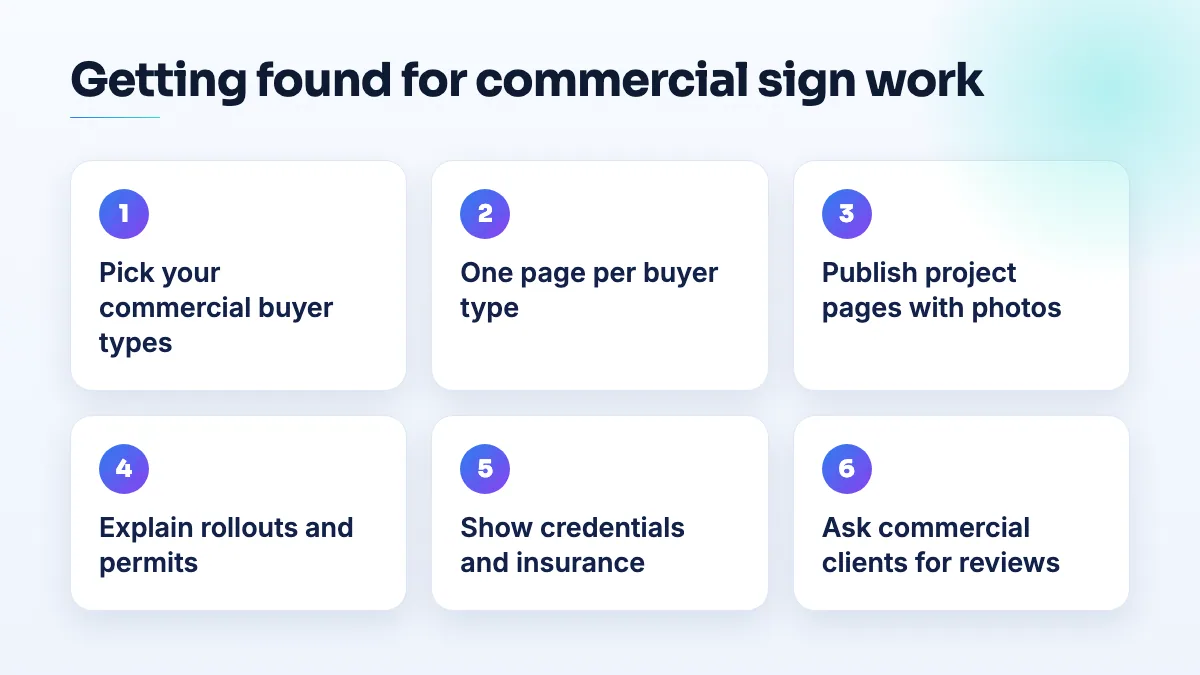
- Pick two or three commercial buyer types you actually want. Look at your last two years of jobs and circle the commercial ones that paid well and went smoothly. If you've done four apartment communities and one hospital, apartments are your lead. Don't build pages for work you've never done.
- Build one page per buyer type, written for that buyer. "Property manager signage" should talk about monument signs, building numbers, amenity signs, leasing banners, tenant panels and replacing faded signs across a portfolio. "Sign contractor for GCs" should talk about shop drawings, submittals, working to the construction schedule and coordinating with electricians on lit signs. Each page names your service area and shows jobs from it.
- Turn finished commercial jobs into project pages. One page per project: the property type, the problem, what you made and installed, the timeline and the photos. Name the client only with written permission; "a 240-unit apartment community in [suburb]" works fine without it. I cover how to structure these in the guide to project gallery pages.
- Write a multi-site rollout page that explains the process. Site survey, brand standards and approval drawings, permit applications per city, fabrication, a scheduled install per location, and a single point of contact. Buyers with ten locations care more about the process than the price per sign.
- Publish your credentials where a vendor manager can find them. License numbers where your state requires one for sign or electrical work, the fact that you carry general liability insurance and can supply a certificate on request, lift and crane capacity, and whether you handle permits. Put them on one "For contractors and property managers" page and link it from every commercial page.
- Own the permit question. Commercial buyers are nervous about permits, and shops argue about who is responsible for pulling one. A clear page on how you handle permits, what you charge and why you won't install without one is a trust signal a cheaper competitor usually doesn't have. I explain the details in the post on sign permit responsibility.
- Ask your commercial clients for Google reviews that mention the property type. A review from a property manager saying you replaced signs across three buildings on schedule does more for commercial searches than ten reviews for banners. Ask when the last sign goes up. Don't script what they say.
What proof property managers and GCs want to see
When I review a sign shop's site for commercial work, this is the checklist I use. If a buyer can't find each item in under a minute, it may as well not exist.
- Photos of installed commercial signs, not just proofs on a screen. Monument signs in landscaping, lit channel letters at night, wayfinding in a real corridor.
- Scale. The largest number of locations or signs you've handled in one job, stated plainly and honestly.
- Service after install. Who they call when a letter goes out or a panel cracks, and how fast you respond.
- A real business behind the site. Your address, how long you've been operating, the owner's name and a direct phone number.
- Reviews that don't worry them. Sign people say bad reviews cost them work; one owner in a Signs101 thread about asking customers for Google reviews admitted passing up quite a few businesses because of them. Commercial buyers read reviews the same way. Reply to every negative one calmly and specifically.
What not to do
- Don't copy one commercial page and swap the property type. A page for hospitals that says the same thing as the page for apartments tells the buyer, and Google, that you've done neither.
- Don't build a page for every city in your state. Contractors have reported location pages dropping out of Google's index this year. One strong page per buyer type, with your real service area, is safer and more useful.
- Don't lead with banner prices on your commercial pages. A property manager who lands on "Banners from $29" thinks you're a print counter, not a contractor.
- Don't claim clients or volumes you can't back up. Vendor managers check. One inflated logo wall can end a relationship before it starts.
- Don't stop at the website. The first commercial job from a property management company is usually the audition for the rest of its portfolio. Follow up after every install with photos and a short summary they can forward.
Questions sign shop owners ask
Can a small shop really compete with the franchises for commercial work?
For regional work, yes. A franchise has the national ad budget, but a property manager with buildings in your area wants the shop that can be on site tomorrow. Make your service area, response time and local installs obvious.
Do I need a separate site for commercial clients?
No. One site with a clear commercial section is easier to run and keeps all your reviews and history in one place. A split site usually means two weaker sites.
How long before these pages bring in work?
Commercial buying cycles are slow, and I won't promise a timeline. What I will say is that a buyer who finds a page about exactly their property type, with photos of that work nearby, is far more likely to put you on the bid list than one who finds a homepage full of banners.
Where to start
Pick your strongest commercial buyer type, write that one page properly and add three project pages behind it. Then do the next one. Getting commercial pages in front of buyers is the kind of work our B2B SEO service covers, and it's a big part of the sign company SEO projects I run.
Written by Saifur Rifat, Founder & SEO Lead at SERP Squad.