

Kumon, Sylvan and Mathnasium own the searches for their own names and outspend you on everything broad, so fliers and generic ads for "tutoring" mostly pay for their brand awareness, not yours. Tutoring business marketing works for an independent center when you stop competing for the general term and go after the specific searches parents type when they have a specific problem: a subject, a grade and an exam.
The cost of getting this wrong is real. The owner of a tutoring company in a Reddit thread from a tutoring company that spent about $2,000 for zero students described a year of marketing with no return and was thinking about closing. Tutors in a Reddit thread from tutors whose fliers and Facebook posts produced nothing tell the same story with library boards and local groups.
Below is why those channels fail, the searches I'd target instead, the Google profile setup, and what I'd avoid.
Why fliers and broad ads don't work for a tutoring center
A parent doesn't wake up wanting "tutoring". They want their daughter to pass grade 10 math, their son to get ready for the SAT, or their child to catch up on reading after a bad year. A flier on a library board or a general Facebook ad reaches people at a random moment, usually not the week the problem hits.
Broad paid search has a different problem. When a parent searches a general term, the franchises are already there with national budgets and names the parent recognizes. Owners in a Reddit thread from tutoring owners who tried every marketing channel describe running through fliers, libraries and social media with little to show. None of those channels are wrong in themselves. They just aren't where a worried parent looks when they need help with one subject this month.
The searches an independent tutoring center can win
Franchises sell a method. You can sell a fix for a specific problem, taught by named people, close to home. The searches that match that are narrow and practical:
| Type | The kind of search parents make | What your page needs |
|---|---|---|
| Subject | Chemistry tutor, algebra help, essay writing tutor near them | Who teaches it, what's covered, how sessions work, results you can actually show |
| Grade level | Grade 9 math tutor, high school physics help, early reading support | The curriculum you follow at that grade, typical problems you fix, group or one-to-one |
| Exam | SAT prep, ACT prep, entrance exam or provincial and state test preparation | Test dates, how many weeks to start before, practice test schedule, price for the course |
| Need | Help for a child who's fallen behind, study skills, homework help after school | How you assess a new student, how you report progress to parents |
These searches have fewer people behind them than "tutoring", but the people searching them are closer to booking, and the franchises rarely have a local page for each one. That's the gap.
Tutoring business marketing that works, step by step
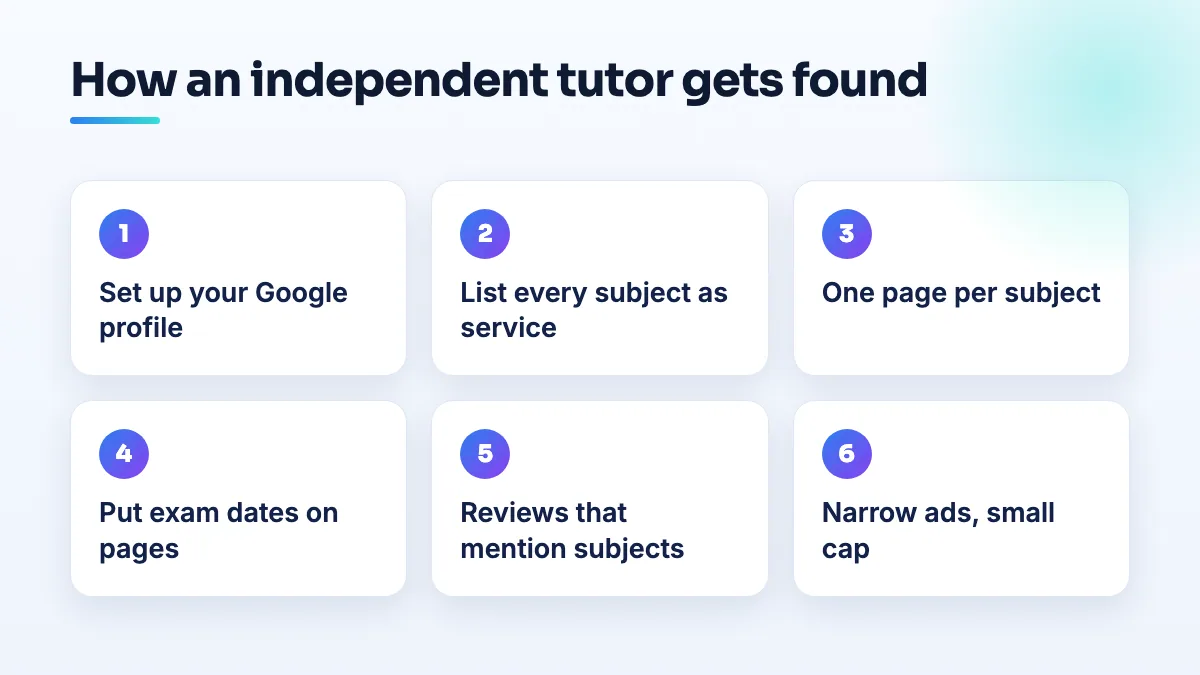
- Set up your Google Business Profile correctly. If families come to your center, verify it at that address with your real name, hours and phone. If you travel to students' homes, list as a service-area business with the home address hidden. Google's eligibility rules don't allow a profile for an online-only business, so an online-only tutor can't have one.
- Choose the category that matches your main work and list every subject as a service. Add the subjects, grade levels and exam prep courses you actually teach, each with a short description. That's how Google connects your profile to specific searches.
- Build one page per subject and one per exam you prepare students for. Start with the three that bring in most of your students today. Each page names the tutors who teach it, what a session looks like, the price or how pricing works, and how to book an assessment.
- Put the dates on the exam pages. Test dates, when to start preparing and when your course groups begin. Parents searching for exam prep are working to a deadline. A page with dates answers the first question they have.
- Ask parents for reviews that mention the subject. After a student reaches a milestone, ask the parent to leave an honest review. Don't script it, but it's fine to say "it helps other parents if you mention what we worked on." A review that says "physics" helps a parent searching for physics help.
- If you run ads, run them on the narrow terms only. Point an ad for chemistry help at the chemistry page, not the home page. Set a small monthly limit and check which ones bring enquiries before spending more.
- Follow up every enquiry the same day. A parent who contacts three centers usually books with the first one that calls back.
Writing a page per subject and exam is the part most owners never get to, because it takes time they don't have. It's also where the results come from, and it's the kind of content writing we do for tutoring clients.
Should each tutor have their own Google profile?
Usually not. Google's guidelines on individual practitioners allow a separate profile only for someone in a public-facing role who can be contacted directly at the verified location during stated hours. A tutor who teaches a few evenings a week at your center rarely fits that.
There's also a ranking cost. When several profiles share one address and similar categories, Google tends to show one and filter the others out. Local SEO specialists in a Local Search Forum discussion on practitioner listings at one address describe exactly that. I'd rather put your tutors on your website, each with their own bio and subjects, and keep one strong profile for the center.
Where a first marketing budget should go
I can't tell you where the $2,000 in that thread went wrong without seeing it. What I can tell you is the order I'd spend a small budget in for an independent center:
- First, the free foundations. A correct Google profile with services, photos and hours, and replies to every review.
- Second, the pages. The three subject or exam pages that match the students you already teach best.
- Third, reviews. Steady, honest reviews from parents, spread over time.
- Last, paid ads, limited to the narrow terms, pointed at the matching page, with a monthly cap you're prepared to lose while you test.
The same principle applies when a directory or aggregator site sits above you. I explain how independent businesses compete with directories in search in a separate guide.
What not to do
- Don't bid on the franchise names. A parent searching for Kumon usually wants Kumon. You pay for clicks from people who were never going to switch.
- Don't copy the franchise's language. "Personalized learning" means nothing to a parent. "Grade 11 chemistry, taught by a former high school chemistry teacher, two evenings a week" means a lot.
- Don't create a profile for each tutor at your address. It risks the filter and splits your reviews.
- Don't pay for reviews or post them yourself. Parents talk. A fake review found out in a parents' group costs more than it earned.
- Don't keep paying for a channel with no enquiries. Give any channel a set test period and a set budget, then stop if it produces nothing.
Compete where the franchises don't
An independent tutoring center won't beat Kumon for "Kumon". It can win the parent looking for help with one subject, one grade or one exam this month. If you want the profile and subject pages built, it's what our tutoring SEO work covers, alongside our wider local SEO services.
Written by Saifur Rifat, Founder & SEO Lead at SERP Squad.