

A parent types your school's name into Google and the first things they see are Niche and GreatSchools, with a rating you didn't choose, above your own website. You can't remove those sites or change their score, but you can make sure your own result, your Google profile and your own pages give parents the full picture before they settle on a number.
GreatSchools ranking above your school for its own name is common, and it matters more than most schools admit. Families moving house use these ratings to pick neighborhoods, and parents and teachers describe the same district rated average on one site and near the top on another. When the rating is the first thing a family sees, it becomes your first impression.
Here is why it happens, what I'd do to strengthen your own result, and how to handle the ratings themselves without making things worse.
Why GreatSchools is ranking above your school's own site
Rating sites rank for school names because they have a page for every school, those pages are linked from thousands of other pages on the same site, and they answer the question a parent is really asking: is this school any good? Your own site often answers a different question. It has a welcome message, the calendar and the lunch menu. It rarely says, in plain words, what the school offers and how it performs.
Parents are not neutral about these ratings either. In a Reddit thread where home buyers discuss school ratings, buyers talk about ratings as a deciding factor for where to live. In a Reddit thread where parents discuss GreatSchools ratings, parents debate what the number actually tells them, and in a Reddit thread where teachers discuss school rating sites, teachers push back on what the ratings capture. That debate is the opening for your school. Parents already suspect the number isn't the whole story. Your job is to be the result that tells the rest of it.
I see the same pattern well beyond schools. Directories and aggregators sit above the business's own site in dozens of industries, and I've written about why directories outrank my website is one of the most common complaints I hear.
How to strengthen your school's own search result
The aim is not to push the rating sites off the page. It's to make sure that, next to them, a parent sees your official site with useful links, your Google profile with real photos and reviews, and pages that answer their questions better than a single score.
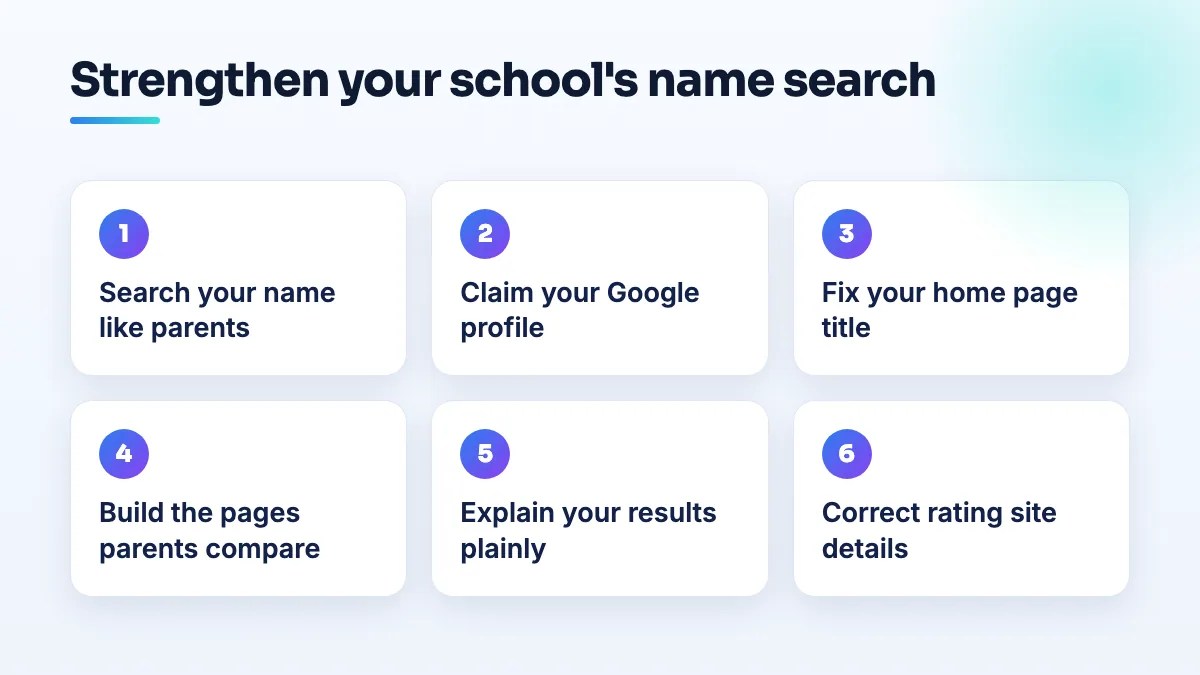
- Search your name the way parents do. In a private browser window, search the school's name, the name plus your town, and the name plus "reviews" and "rating". Screenshot each page with the date. This is your starting point, and it shows you which rating sites matter in your area.
- Claim and complete your Google Business Profile. Verify it under an account the school controls, not a staff member's personal account. Choose the category that matches what you are, add your real hours, office phone, website and grades or ages served, and upload photos of classrooms, grounds and events (without identifiable children unless you have consent). The profile is the panel that sits beside the search results, and it's often more visible than the rating sites.
- Fix the title of your home page. The page title should start with the school's full name, the type of school and the town, not "Home" or "Welcome". It's what Google shows as your blue link, and it's what tells Google this is the official page for the name.
- Build the pages parents compare schools on. Admissions and how to apply, tuition and fees if you charge them, class sizes, curriculum and programs, before and after care, and how to book a tour. Each one gets its own page with a clear heading. These are the pages that show up as extra links under your result.
- Explain your results in your own words. One page that says what your recent results were, what they mean, what's changed and what you're proud of. You don't need to argue with a rating site. Give parents the context the number leaves out.
- Correct your details on the rating sites. Check your listing on each site that shows up for your name: address, website link, phone, grades served, and whether the school is shown as open. If a site offers a school account or a way to submit corrections, use it, and make sure the website link goes to your official site.
Expect the first changes on Google within weeks for the profile and title, and months for the new pages to start appearing. This is steady work, not a switch.
How to respond to how rating sites portray your school
The instinct is to fight the rating. I'd put that energy elsewhere. What you can influence is the information the sites show, what parents read next to the rating, and the reviews on your own profile.
- Send parents to reviews on your Google profile. Ask families at natural moments, such as the end of the year or after a successful event, to leave an honest review. Don't write the review for them, and don't offer anything for it.
- Don't ask staff to review the school. Google's contribution policy on conflicts of interest covers current and former employees. Staff reviews can be removed and make the whole profile look less trustworthy.
- Reply to reviews on Google calmly and briefly. Thank people for positive reviews. For negative ones, acknowledge the concern, give the office contact, and never discuss a specific child or staff member. Childcare providers in a Reddit thread from educators named in a parent's Google review describe how hard it is when a review names an individual. Replying with names makes it worse.
- Give families something better to share. A page about your results, a short tour video, the calendar of open days. When a parent asks a neighborhood group about your school, those are the links you want people posting.
What's different for private schools, daycares and public schools
- Private schools usually control their own website and profile, so they can do every step above quickly. The pages that matter most are tuition, admissions and tours, because that's where a parent decides whether to apply.
- Daycares and preschools are often judged on very thin Google profiles. Parents in a Reddit thread where parents compare childcare reviews online describe listings with a handful of reviews and one angry one deciding the average. For a new center, the first reviews matter enormously, which is why I cover new daycare marketing separately.
- Montessori and specialist schools should check their category closely. In a Help Community thread from a Montessori preschool unable to change its category, the school found it couldn't switch category and that reviews were blocked on the profile. If reviews won't post on your profile, ask in the Help Community with the exact category and what happens when a parent tries.
- Public schools often have their website and profile controlled by the district. Work with the district's communications team rather than creating your own profile or site, and focus on the pages you can update.
Schools with several sites have an extra decision to make about their Google listings. I answer that one in the question on multi campus school Google profiles.
What not to do
- Don't create fake or incentivized reviews on Google or on the rating sites. Parents spot them, and Google removes them.
- Don't attack a rating site on your website. Explaining your results is useful. Arguing with a rating looks defensive, and it repeats the number you're unhappy with.
- Don't let a staff member own the Google profile. When they leave, the school loses access. Use a school account and add staff as managers.
- Don't create a second profile to escape bad reviews. Duplicate listings for one school confuse parents and are the kind Google merges or removes.
Questions schools ask
Can we get a rating site to remove our page?
I wouldn't count on it. Correct the facts, use any school account the site offers, and focus on the results and pages you control.
Will our own site ever rank above the rating sites?
For the exact school name, often yes once the title, profile and key pages are right. For searches like "best schools near me", rating sites will usually stay strong. That's why the Google profile matters so much: it shows up in both.
Start with what parents see first
The rating sites aren't going away, but they don't have to be the only thing a parent reads. If you want your school's name search and profile set up properly, it's the first step of our private school SEO work, and the profile, reviews and local pages are all part of our local SEO service.
Written by Saifur Rifat, Founder & SEO Lead at SERP Squad.