


Key points
- A lease alone doesn't prove a separate location
- Staff the office during the hours you list
- Use a local phone number that rings there
- Link each listing to its own location page
- Change one listing at a time
Your second office is real, it has a lease and a sign, and Google still treated it as a duplicate of the first or suspended it outright. A second office Google Business Profile duplicate flag usually means Google can't see enough that makes the new location different from the one it already knows: the same phone, the same web page, the same categories, and staff who are really based at the main office.
Law firms and financial advisors hit this more than most, because satellite offices are common in both and are often staffed part of the week. Here is why it happens and how I'd set the second office up so it stands on its own.
Why a real second office gets flagged as a Google Business Profile duplicate
The clearest case I've read is a Help Community thread from a Texas law firm whose satellite office was flagged as a duplicate. The firm had a lease, a certificate of occupancy, insurance and permanent signage at the satellite office, and it was still treated as a duplicate. When the firm tried to follow up, support forms led to noreply addresses, Google rejected the format of its case ID, and the firm couldn't even get a Business Profile ID for the suppressed listing to quote in its appeal.
That case shows the problem clearly. The paperwork proves the office exists. It doesn't prove the office operates as its own location. Google's checks are looking at the listing, and a listing that repeats the main office's phone number, website page and hours looks like the same business listed twice.
Financial advisors see the suspension version. A Help Community thread about a new branch office suspended on Google is one of many where the new location went down while the head office listing was untouched.
Google's guidelines for representing your business set the bar for any office in a shared or serviced building: clear signage, customers received there during business hours, and staff from your own business on site during those hours. A satellite office that's open two days a week, in a serviced suite, answered by the head office phone, fails more of that than owners realize.
How to set up the second office so it stands on its own
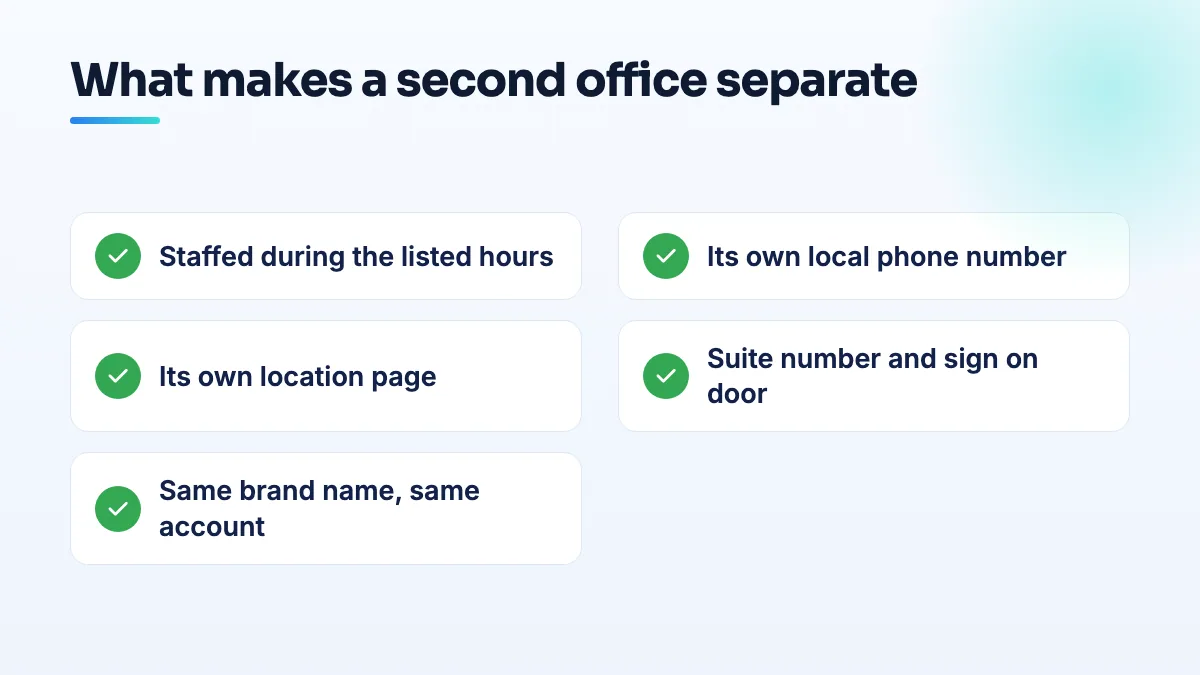
- Staff it during the hours you list. If someone from your firm is there Tuesday and Thursday, list Tuesday and Thursday. Hours that promise a full week at an office nobody answers are the weakest point in most satellite listings.
- Give it its own local phone number. A number with the local area code that rings at that office, or at least rings to a person who handles that office. Reusing the main number is the fastest way to look like a duplicate.
- Build a location page for it. A page on your site with that office's address, suite number, phone, hours, the people who work there and directions. Link the listing to that page, not to your homepage.
- Put the suite number everywhere, the same way. On the listing, the website, your letterhead and the directories. If it's in a serviced building, your name has to be on your own door, not just the building's lobby board.
- Keep the name identical to the main office. Same brand name on both listings. Don't add the town or "Downtown Office" to the name; that reads as keyword stuffing, and the address already tells people which office it is.
- Verify the new office from the same account as the main one. Both listings in one business account, in the same location group, so Google sees one organization with two locations rather than two unrelated profiles.
- Don't edit the main office while the new one is under review. One change at a time, so a flag on one doesn't spread to the other.
If it's already been flagged or suspended
Gather evidence that speaks to the actual question, which is whether this is a separate, staffed location. Photos of your sign on your own door, the inside of the office with your staff, the lease showing the suite, a utility bill in the firm's name at that suite, and a screenshot of the location page. The lease on its own was not enough in the Texas case. If your appeal was already denied, my guide to Google Business Profile appeal evidence covers why the right evidence matters more than the amount.
Then post in the Help Community with your case ID, both Maps links and a short list of what makes the offices separate. A Product Expert can see in a minute whether the listing looks like a duplicate and can escalate a clear case.
If Google has actually merged the two into one record, or created a third copy along the way, that's a different job. The steps to fix a duplicate Google Business Profile apply, and the order matters.
What changes for lawyers and advisors
Law firms. Watch for practitioner listings. If each attorney also has a listing at the firm's addresses, Google now sees several listings on two addresses, and forum regulars report that multi-attorney listings at one address tend to get filtered or merged. I'd get the office listings right before adding attorney listings to the new office. It's the first thing I look at in law firm SEO for multi-office firms.
Financial advisors. Google lists financial planners as individual practitioners, and its naming rules change depending on whether you're the only public-facing advisor. A branch office where one advisor works needs a different setup from one with several advisors, so decide which listings you actually need before creating any. The financial advisor SEO setups we build start with that decision.
Either way, if you'd like the second location set up and checked before it goes live, it's routine work in our Google Business Profile management.
People also ask
Can you use a coworking space or virtual office for Google Business Profile?
Only with your own dedicated office there. Google allows a coworking address only if the office has clear signage, receives customers during business hours, and is staffed during those hours by your own staff, not the operator's reception. A virtual office, mailbox, hot desk or day pass doesn't qualify, and profiles listed at them are regularly suspended.
Read the full answer: Can you use a coworking space or virtual office for Google Business Profile? →
Why does only one practitioner at our office show up on Google Maps?
Because Google's local filter usually shows only one of several listings that share an address and a category. It isn't a penalty, and the other listings still exist; they're hidden for that search. Agents, advisors, lawyers and instructors at one office trip it most. Different primary categories, direct phone numbers, genuine suite numbers and each listing's own reviews reduce it.
Read the full answer: Why does only one practitioner at our office show up on Google Maps? →
Should each practitioner in a practice have their own Google Business Profile?
Only the practitioners people search for by name, and only if each is public-facing and reachable at the practice during set hours. Google allows individual profiles for doctors, dentists, lawyers, financial planners and agents, but listings at one address are often filtered, and each needs its own reviews. Give listings to key practitioners, make each distinct with its own category and phone, and keep everyone else on the practice listing.
How should a doctor, lawyer or advisor name their Google Business Profile?
It depends on whether you're the only public-facing practitioner at that location. If you are, Google allows your brand followed by your name, as in its own example "Allstate: Joe Miller". If several practitioners share the office, the title should be only your name, without the firm's name. You can add a title or degree such as Dr., MD, JD, Esq. or CFA, and the name should match your license records.
Read the full answer: How should a doctor, lawyer or advisor name their Google Business Profile? →
Can an agency's restricted Google account get my profile suspended?
Yes. If an agency, freelancer or vendor with access to your listing has its Google account restricted, Google can suspend every profile connected to that account, and yours goes with it. The notice says a Google account associated with the profile was restricted. Proving your address won't fix it: remove the account, have the agency resolve its restriction, and appeal on that point.
Read the full answer: Can an agency's restricted Google account get my profile suspended? →