

Motor club work keeps trucks moving, but a club can pay you $35 to $55 for a tow that a dealership would bill $125 for. The motor club vs cash calls question in towing comes down to one sum: every club call you replace with a cash call from Google is worth the gap between the two, and one towing trainer puts a cash call at roughly 2.4 times what a club call nets on the same 12-mile run.
That gap is what local search visibility is worth to you. Below is how to put your own number on it, where police rotation work fits, and what it takes to get the cash calls in a category Google watches more closely than most.
Motor club vs cash calls in towing: what each tow pays
These are the figures from the towing sources I trust for this, set side by side. Your own rates will differ by market, so treat them as a starting point, not a quote.
| Type of call | What the sources report |
|---|---|
| Motor club tow | $35 to $55 paid to the tower, for a tow a dealership charges $125 for |
| Cash or private-property tow | Roughly $87 to $253 per hook |
| Cash call vs club call, same 12-mile run | The cash call nets about 2.4 times as much |
The motor club figures come from a dispatch software company's comparison of motor club pay against retail towing rates, which makes the point that the club keeps the difference. The 2.4 times figure comes from a training site's walkthrough of getting on the police rotation list in Huntsville, Alabama, which compares a cash call with a club call on the same distance. The per-hook range for cash and private-property work appears in that piece and in a guide to towing contracts, police rotations and motor clubs.
Why club and rotation work still has a place
I'm not going to tell you to drop your clubs. Club calls fill idle trucks and idle drivers, and a club tow on a quiet Tuesday beats a truck sitting in the yard. Rotation work gives you a steady flow from the police without marketing at all.
The problem is dependence. When most of your volume comes from clubs, the club sets your rate, and a tow company with no cash calls has nothing to bargain with. Every cash call you add moves a little of that power back to you.
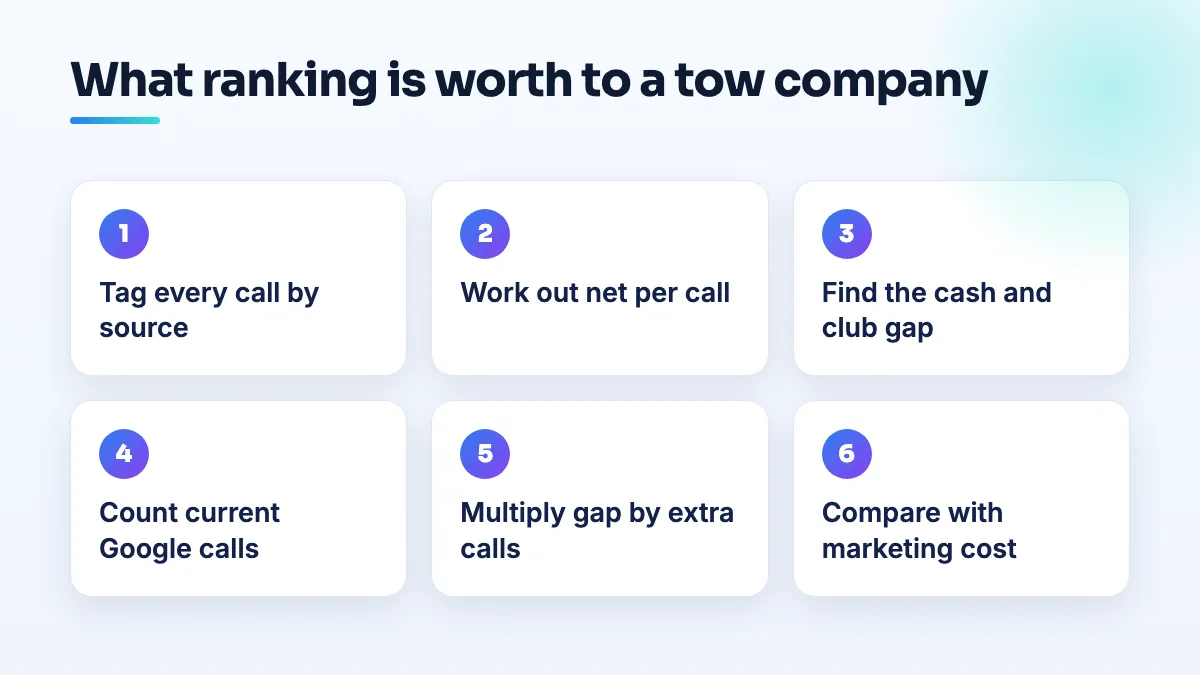
How to work out what ranking is worth to your tow company
- Pull three months of calls and tag each one by source. Motor club, police rotation, repeat customer, referral, Google profile, website, other. If your dispatch software records the source, export it. If it doesn't, start asking every caller "how did you find us?" and write it down from today.
- Work out what each type of call nets you. Take the average revenue per call for each source and subtract fuel, driver pay and the miles you drive empty to reach the car. Count the empty miles for every type of call, not just the loaded ones.
- Find the gap between a cash call and a club call. Subtract your club net from your cash net. If the sources above are anywhere near your market, the gap is large.
- Count the cash calls you already get from Google. Look at the calls reported in your Google Business Profile performance data and your website's call tracking, and compare them with the Google-tagged calls in your log. That's your baseline.
- Multiply the gap by the extra cash calls you could realistically add. Be conservative: think in handfuls of calls a week, not hundreds. The result is the most a month of better visibility is worth to you.
- Compare that number with what marketing would cost. Ads, SEO, a better website. If the cost is well under the value of the calls, it's worth doing. If you run ads, set a ceiling first using a max cost per lead calculation, because tow searches get expensive fast.
- Recheck every quarter. Keep tagging calls. The only number that matters is the net from cash calls going up while the reliance on club calls goes down.
Police rotation list towing: where it fits
Rotation work is assigned by the agency, not won through search. Each department or state sets its own requirements for getting on the list, from equipment and insurance to response times and yard standards, and the Huntsville walkthrough shows how specific those can be. Ranking on Google won't put you on a rotation.
What rotation work doesn't do is replace a direct customer base. Lists change, requirements change, and the calls come on the agency's schedule, not yours. I'd treat rotation as a steady floor and cash calls from search as the part of the business you control. If you're on a rotation and wondering whether you still need Google, my answer is yes, for exactly that reason.
What it takes to get cash towing calls from Google
Towing is not a normal category on Google. When a Tampa tow company's verified profile didn't show up even for its own name, Gold Product Expert Tony Gricar replied in a Help Community thread about a tow company invisible for its own name that "Google does put greater scrutiny on towing companies". That affects how you set up everything.
- Get the three basic settings right. A suspended tow operator in a Help Community thread from a suspended towing operator named his own mistakes: a service area covering the entire country, a physical address that wasn't hidden, and a missing category. Hide the address if customers don't come to your yard, set the service area to where your trucks actually go, and use the towing category.
- Don't expect the service area to rank you everywhere. It tells customers where you go, but your visibility still centers on your location. I explain this in the answer on service area vs address ranking.
- Make changes rarely and all at once. Owners report that edits to towing profiles trigger reviews and sometimes suspensions. Plan your edits, make them together, then leave the profile alone. More on this in the post on towing listing extra scrutiny.
- Build a page for each service people search for. Flatbed towing, roadside assistance, lockouts, jump starts, heavy-duty and private-property towing, each with your response area and your number at the top.
- Answer every call, day and night. A cash caller on the side of the road calls the next listing if you don't pick up. Missed calls cost more in towing than in almost any other trade.
- Ask for reviews after good tows. A text with your review link after a stressful breakdown handled well gets answered more often than you'd think.
You're also competing with spam. 9NEWS in Denver reported residential homes listed as towing companies on Google Maps, around a dozen of them. If fake listings are taking your calls, report them together, as a network.
What not to do
- Don't cancel club contracts before cash calls replace them. Build the cash side first, then decide which clubs are worth keeping.
- Don't hire the cheapest SEO you can find. In a Local Search Forum thread on towing verification and audits, Joy Hawkins linked an owner's reviews to a known spam network, likely through a cheap contractor doing reputation work. In a watched category, that can sink the profile.
- Don't put "24/7 tow truck near me" in your business name. Keyword names are a suspension trigger, and towing already gets extra scrutiny.
- Don't open fake locations to cover a bigger area. It's the exact tactic Google is watching towing for.
Where to start
Start tagging every call by source this week. In a month you'll know your real split and the real gap between a cash call and a club call, and you'll know what ranking is worth before you spend a dollar on it. If the number says it's worth pursuing, that's the work we do in towing SEO and across our local SEO services.
Written by Saifur Rifat, Founder & SEO Lead at SERP Squad.