


Key points
- A license is not a location Google can list
- Keep one profile based where you actually work
- Cross the state line only where you really go
- Mailboxes and virtual offices don't qualify
- Use website pages for the other states
You hold a license in two or three states, you live in one of them, and you want to show up on Google in all of them. For a realtor licensed in multiple states, the Google Business Profile answer is usually one profile, based where you actually live and work, with a service area covering the places you really serve. A license is permission to sell there. It isn't a location, and Google lists locations.
An agent in exactly this position asked on the Local Search Forum how to structure their profile and Local Services Ads across states. Here's how Google's rules apply, and what to do in each common setup.
Why a license doesn't earn a second listing
Google's eligibility rules allow a profile for a business that has a physical location customers can visit, or that travels to customers in person. They also rule out a rented mailing address the business doesn't operate from, along with P.O. boxes and remote mailboxes. So a mailbox or a friend's address in the second state doesn't qualify, however valid your license is there.
Shared and virtual offices don't get around it either. A Product Expert community guide on business addresses explains that a service-area business can't list a virtual office unless that office is staffed during business hours. And Google's practitioner guidelines, which name real estate agents, say a practitioner shouldn't have a profile at a location where they can't be contacted directly during the stated hours.
How a realtor licensed in multiple states should set up a Google Business Profile
This is the setup I'd use for an agent who lives in one state and is licensed in others, as posted in a Local Search Forum thread from an agent licensed in several states but living in one.
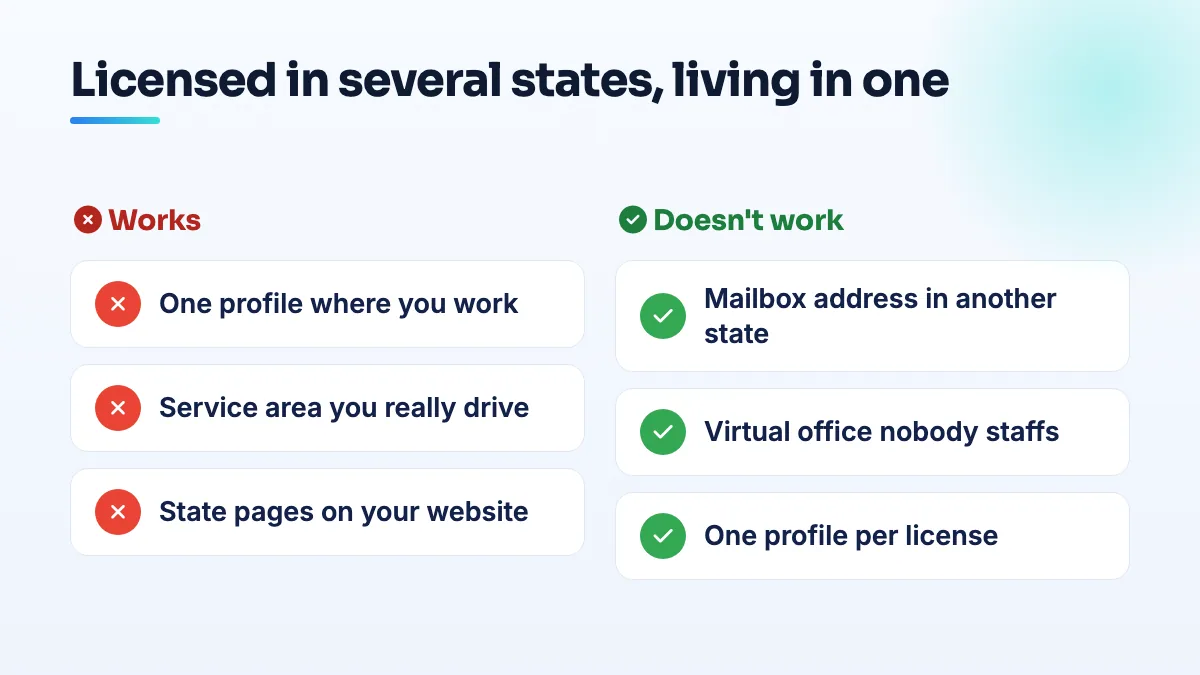
- Base the profile where you live and work. For most agents that's the home address, hidden, as a service-area business. I explain whether a realtor should hide their home address or use the brokerage office in a separate answer.
- Draw the service area around where you really go. If you live near a state line and show homes on both sides every week, include the towns across the line. If the other state is five hours away and you go twice a year, leave it out. Product Experts have told mobile businesses to keep service areas within roughly a two-hour drive of their base.
- Don't add an address in another state unless you have a real office there. That means a space you work from on set hours, where clients can reach you directly. If you do, that office can have its own profile, with its own phone number, verified at that address.
- Cover the other states on your website instead. Give each state a page with your license number for that state, the areas you actually cover there, and reviews from clients you helped there. That's where out-of-state searchers and referrals will check you out.
- Set up Local Services Ads to match. It's a separate product with its own service areas and checks. Only target the areas where you hold a license and genuinely take clients, and keep them consistent with your profile.
Will the service area make you rank in the other state?
Not by itself. The service area tells customers where you go, but your ranking in the map results still leans heavily on where you're based. Adding a town two hours away rarely puts you in its map pack. I go through it in the answer on whether your service area affects Google ranking. For the distant state, your website pages, your name search and referrals will do more work than the profile.
Edge cases
- You moved from one state to the other. Change the address on your existing profile rather than creating a new one, and change it in one careful edit, because address changes are a common suspension trigger.
- You split the year between two homes. Keep one profile at the home you work from most. Two profiles for one agent is a duplicate.
- Your team has agents living in each state. Each agent can have their own profile where they live and work. That's several people, not one person with several addresses.
- Your brokerage has an office in the other state. It only counts for you if you actually work from it on set hours. Otherwise it's the brokerage's location, not yours.
The instinct is to add listings first and read the rules later. Doing it the other way round keeps the one profile you have safe. It's part of how I set up SEO for realtors, and it's the kind of structure we build in Google Business Profile management.
People also ask
Can you use a coworking space or virtual office for Google Business Profile?
Only with your own dedicated office there. Google allows a coworking address only if the office has clear signage, receives customers during business hours, and is staffed during those hours by your own staff, not the operator's reception. A virtual office, mailbox, hot desk or day pass doesn't qualify, and profiles listed at them are regularly suspended.
Read the full answer: Can you use a coworking space or virtual office for Google Business Profile? →
Why does only one practitioner at our office show up on Google Maps?
Because Google's local filter usually shows only one of several listings that share an address and a category. It isn't a penalty, and the other listings still exist; they're hidden for that search. Agents, advisors, lawyers and instructors at one office trip it most. Different primary categories, direct phone numbers, genuine suite numbers and each listing's own reviews reduce it.
Read the full answer: Why does only one practitioner at our office show up on Google Maps? →
How should a doctor, lawyer or advisor name their Google Business Profile?
It depends on whether you're the only public-facing practitioner at that location. If you are, Google allows your brand followed by your name, as in its own example "Allstate: Joe Miller". If several practitioners share the office, the title should be only your name, without the firm's name. You can add a title or degree such as Dr., MD, JD, Esq. or CFA, and the name should match your license records.
Read the full answer: How should a doctor, lawyer or advisor name their Google Business Profile? →
Should a realtor use a home address or the brokerage office on Google?
For most agents, the home address, hidden, with a service area covering the towns you actually sell in. Google allows it because agents travel to clients. The brokerage office with your own suite number also works, but only if you really work from that office, and profiles at a busy brokerage address are hard to verify and usually filtered out of the results even when they pass.
Read the full answer: Should a realtor use a home address or the brokerage office on Google? →
Why does my profile get suspended again after passing video verification?
Because video verification only proves your business is real and operates where you say. It doesn't fix what triggered the suspension. If an eligibility problem is still on the profile, such as a visible home address on a service-area business, a service area far wider than you travel, a missing category, keywords in the name or details that don't match across the web, the next automated review finds it again.
Read the full answer: Why does my profile get suspended again after passing video verification? →