

You own the trucks, you employ the crews, and the company above you in Google has neither: it sells the move and hands it to a carrier like you. In the moving broker vs carrier fight for search, brokers usually win on marketing, not on service, and a carrier beats them by proving on every page and profile that it's the one who shows up, then by reporting the broker listings Google shouldn't be showing at all.
This hits long-distance movers hardest, because that's where brokers spend their money. It also hits local movers whose map pack has filled with listings that forward calls to a lead center.
Here's why brokers outrank you, what I'd change on your site and profile, and how to report the listings that break Google's rules without wasting months on it.
Why brokers outrank the carriers who do the moving
A carrier that holds both kinds of authority put it plainly in a carrier's guide to moving companies that are not brokers: brokerages are usually better at marketing and branding. That's the whole story in one line. A brokerage's product is the lead. It spends on ads, national websites, comparison pages and review platforms, because that's where its revenue comes from. A carrier's product is the move, and its marketing budget usually competes with fuel, trucks and payroll.
The same writer asserts that the large majority of companies selling moves online are brokers. I'd treat the exact share as an industry claim rather than a measured number, but anyone who has searched for a long-distance mover has seen the pattern.
The money explains why this matters to you. According to a moving-lead price comparison from a mover software vendor, shared leads typically go to between 3 and 10 movers. Its worked example: at $60 a lead with 40% contact and 25% close rates, you need ten leads per booked job, which is $600 a job. Every customer who finds you directly in search instead of through a lead seller is a job you didn't have to buy.
What Google allows a broker and a carrier to list
A Google Business Profile is for a business that serves customers in person, from a real location or by going to them. A carrier fits: you have a yard or office, trucks and crews who go to the customer's home. A broker with no trucks and no crews at a location doesn't move anyone in person.
That's why brokers running profiles as movers are treated as ineligible. In a Help Community thread about brokers listed as moving companies, a mover laid out the problem, a redressal case was filed, and a month later nothing had been removed. Ineligible and removed are not the same thing, which is why the reporting section below is about patience and evidence.
It gets worse at the spam end. A Help Community thread documenting over 110 fake moving profiles found listings on residential addresses, virtual offices and bare intersections, with calls forwarded to call centers that resell the lead. Many of them chose "logistics company" as their category to dodge the stricter video verification movers face. I explain that tactic in the answer on fake movers on Google Maps.
How a carrier wins the moving broker vs carrier comparison
You can't outspend a national brokerage. You can make it obvious, to Google and to the customer, that you are the moving company and they are not. These are the steps I work through with carriers.
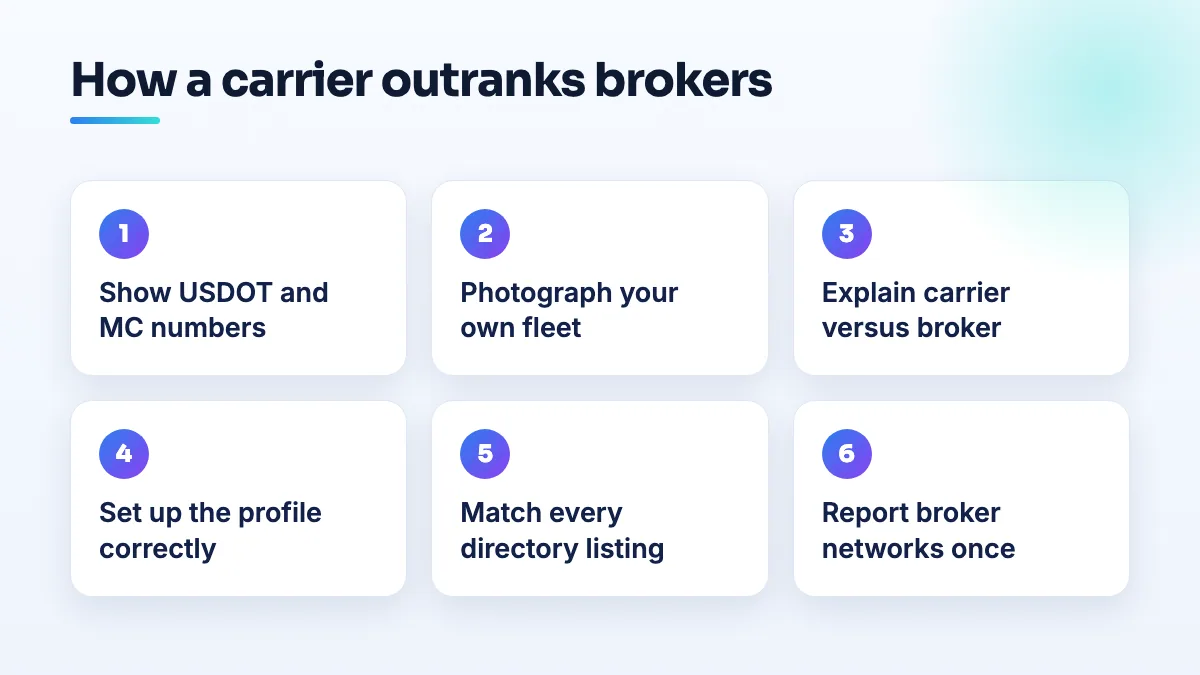
- Put your authority numbers everywhere a customer looks. Your USDOT number, and your MC number if you move interstate, belong in the site header or footer, on the About page, on every quote page and in your profile description. Customers who've been burned by a broker look for these first, and a broker's numbers will say broker when they look them up.
- Show your own fleet and crew. Replace stock photos with real ones: your trucks with the name on the side, your warehouse, your crew in uniform, loading a real job. Add them to the website and the profile. Stock photos are what a lead site uses, and customers have learned that.
- Write the page brokers can't. One clear page that explains who will show up on moving day, who holds the customer's goods, who they call if something breaks, and that the company quoting them is the company moving them. Target "long distance movers not brokers" and similar searches with it. Link to it from every quote form.
- Set your profile up as a carrier. Use the address your crews and trucks actually operate from, the name on your registration and trucks, and moving company as the primary category. If Google refuses that category, read why a moving company primary category gets rejected before you change anything else.
- Make every listing match. The same name, address and phone number on your site, profile, Yellow Pages, BBB, Groupon and every directory. In a Help Community thread from a Huntington Beach mover suspended twice in 48 hours, the cause was traced to inconsistent details across exactly those listings.
- Ask for reviews that describe the move. After each job, ask the customer to say what happened on the day. Reviews that mention the crew, the truck and the date read as a real moving company, because they are one. Never pay for them or write them yourself.
How to report broker listings posing as movers
Report them, but report them properly. One-at-a-time reports disappear. The advice that actually worked in a Help Community thread on reporting mover spam as a network was to submit the whole thing as one documented network, with a spreadsheet.
- Build the spreadsheet first. One row per listing: name, map link, address, phone, category, website, and why it's ineligible. Look for shared phone ranges, identical hours, the same website behind several names, and addresses that are residences, mailbox suites or empty lots.
- Check each one yourself. Look the address up on Street View and search the company name in your state's business register. Call only if you can do it without misrepresenting yourself.
- Submit it once, as a network. Use Google's business redressal complaint form and attach the spreadsheet. Suggest edits on the worst individual listings as well.
- Post in the Help Community if nothing happens. Give the facts and the evidence, not accusations. In a Help Community thread about 50 fake mover listings in one city, a Product Expert escalated the report and Google removed the listings about five weeks later.
Set your expectations by those two threads: sometimes weeks, sometimes nothing. Your own profile and website are the part you control, so don't let reporting replace the steps above.
What not to do
- Don't create extra city listings to match the brokers. A profile at an address you don't staff is the same violation you're reporting.
- Don't stuff your business name. "Cheap Long Distance Movers [City]" is how spam listings are named. Your name is what's on the truck.
- Don't name and shame brokers on your site. Explain the difference and let customers draw the conclusion. Attacking competitors reads badly and can cause you legal headaches.
- Don't buy a lead platform subscription to fix a search problem. Paying for shared leads is a sales decision. It does nothing for your own rankings.
Questions carriers ask
Should a carrier that also brokers overflow jobs say so?
Yes. If some jobs go to partner carriers, say which ones and when. Honesty on that page is what separates you from a broker pretending to be a mover.
Can I rank for long-distance searches in cities I don't have an office in?
In the map pack, not really: your profile ranks around the address it's verified at. In regular search, route pages ("moving from Dallas to Denver") written from real jobs can rank anywhere. That's where most carriers should compete with brokers.
Where to start
Start with steps 1 and 3: authority numbers on every page and a clear "we are the carrier" page. They take a day and they answer the question every burned customer is asking. After that, the profile and listings work is what our moving company SEO covers, as part of our wider local SEO services.
Written by Saifur Rifat, Founder & SEO Lead at SERP Squad.